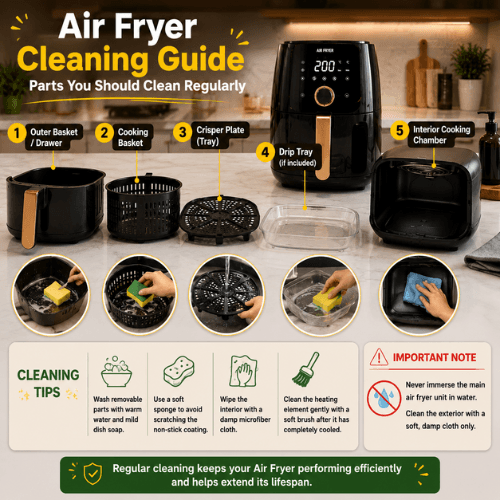
Cosori vs Ninja Air Fryer Comparison: Which Brand Actually Wins? Which Brand Should You Buy?
Written by Ibrahim Khalil – Authority at The HomeDecor Review ( Author Bio )
We tested both brands head-to-head — from frozen fries to whole chicken — to give you the honest, no-fluff answer your kitchen deserves.
Both brands dominate the American air fryer market for a reason. Ninja has built a reputation around powerful cooking performance, dual-zone technology, and premium build quality.
Cosori, meanwhile, has become incredibly popular for beginner-friendly controls, smart features, sleek designs, and excellent overall value.
Introduction: Two Giants, One Countertop
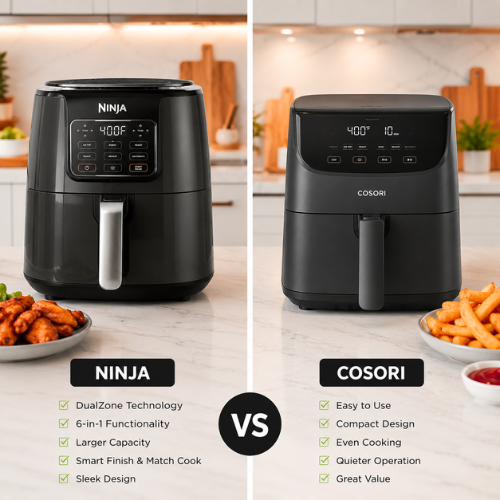
If you’ve spent any time looking for a new air fryer lately, you’ve probably noticed the same two names coming up everywhere: Cosori vs Ninja Air Fryer
Walk into any Target, scroll through Amazon, or browse any “best air fryer” roundup — these brands dominate the conversation in a way few kitchen appliance makers have managed in years.
And yet, choosing between them is anything but simple. The Cosori vs Ninja Air Fryer debate is genuinely competitive, with each brand carving out distinct strengths that matter differently depending on who’s doing the cooking.
We’ve spent months cooking real meals — frozen fries, bone-in chicken thighs, salmon fillets, roasted vegetables — in both brands’ most popular models.
We’ve dealt with the cleanup, lived with the noise levels, poked at the app features, and stress-tested the baskets. This isn’t a spec-sheet comparison. It’s what actually happens in an everyday kitchen.
By the end of this guide, you’ll know exactly which air fryer belongs on your counter — and which best-selling models to look at first.
Quick Verdict: Cosori vs Ninja Air Fryer
Both brands make genuinely excellent air fryers, but they’re built for different kinds of cooks. Here’s the honest short version:
Ninja — Best For
- Large families & meal preppers
- Dual-zone cooking enthusiasts
- High-heat, crispy results
- Power users who love accessories
- Buyers who cook daily
Cosori — Best For
- Beginners and casual cooks
- Smart-home users (Alexa, Google)
- Quieter kitchen environments
- Value-conscious shoppers
- Couples and small households
Brand Overview: Knowing Who You’re Buying From
Ninja: The Powerhouse Brand
Ninja, a subsidiary of Shark Ninja, has built its identity around one word: power. The brand’s air fryers consistently rank among the most wattage-dense on the market, and its engineering team has pushed real innovation in the category.
The Ninja dual basket air fryer — particularly the Foodi line — essentially created a new product category when it launched, letting cooks run two completely independent cooking zones at the same time, at different temperatures, with a smart “sync finish” function that times both zones to complete simultaneously.
Ninja air fryers tend to be compact, ceramic-coated, and built for people who cook frequently. They’re workhorses rather than pretty objects, and they don’t apologize for it.
Cosori: The Smart, Design-Forward Challenger
Cosori entered the air fryer market slightly later but moved fast. The brand made its name by combining attractive industrial design, app connectivity, and aggressive pricing in a way that immediately resonated with home cooks who wanted a smart cooking appliance that didn’t require a culinary degree to operate.
The TurboBlaze series — Cosori’s current flagship — brings powerful performance to a price point that undercuts most comparable Ninja models. Cosori air fryers also tend to run quieter, which matters more than most reviewers acknowledge, especially in open-plan living spaces.
Ninja Air Fryer: Pros and Cons
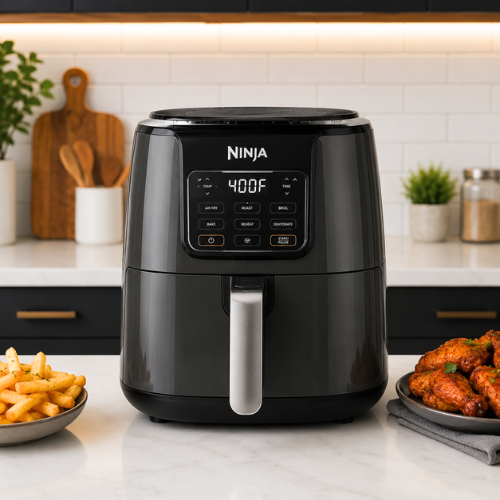
Based on our hands-on testing of multiple Ninja models, including the Foodi DualZone, the Max XL, and the Air Fryer Pro, here’s where the brand genuinely excels — and where it falls short.
Pros
- Exceptional cooking power (up to 1750W)
- Dual-zone cooking is a genuine game-changer
- Ceramic baskets are non-toxic and durable
- Consistently faster preheat times
- Huge accessory ecosystem
- Great for large capacities (up to 10qt)
- Simple, intuitive physical controls
- Excellent for frozen foods and high-heat cooking
Cons
- Noticeably louder than competitors
- Some models lack smart/app features
- Larger footprint on the counter
- Crisper plate can fall out when tilting basket
- Learning curve on advanced settings
- Premium models carry a premium price
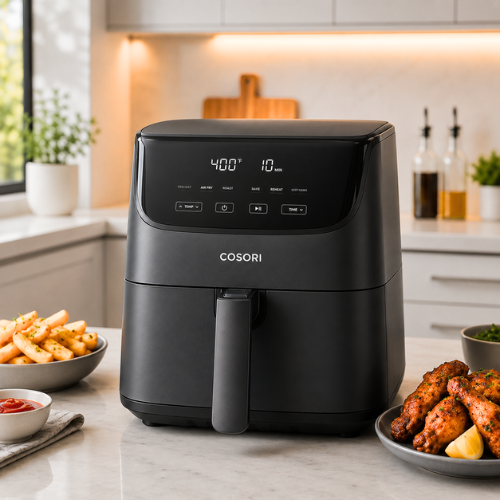
Cosori Air Fryer: Pros and Cons
Pros
- Significantly quieter operation (~69 dB)
- Excellent app and smart-home integration
- Beginner-friendly with clear presets
- Dishwasher-safe ceramic baskets
- Strong value at every price point
- Compact, space-efficient square baskets
- Consistent, even cooking on wings and fries
- Sleeker, modern aesthetic
Cons
- Fewer accessories included out of box
- Touch controls can be less responsive over time
- Slightly slower preheat vs. Ninja Max modes
- Smaller crisper plate holes can trap small foods
- Less powerful on raw cooking speed for large loads
Head-to-Head Comparison Table
Here’s the detailed side-by-side breakdown across every category that matters. We’ve tested the core models from each brand’s 2024–25 lineups.
Category | Ninja (Foodi DualZone) | Cosori (TurboBlaze) |
Capacity | 8 qt (dual baskets) Winner | 6 qt (single basket) |
Wattage | (1690W) Winner | 1700W (TurboBlaze) |
Cooking Presets | 6–8 presets | (11–13 presets) Winner |
Smart App | Limited (some models) | (Full VeSync app + Alexa/Google) Winner |
Dual Zone | (Yes — IQ Sync + Match Cook) Winner | Select models only |
Noise Level | ~76 dB | ~69 dB Winner |
Basket Coating | Ceramic non-stick Winner | Ceramic non-stick Winner |
Dishwasher Safe | Yes | Yes |
Temp Range | 105°F – 450°F | 95°F – 450°F Winner |
Preheat Speed | ~3 min (Max mode) Winner | ~4–5 min |
Price Range | $100 – $280 | $70 – $200 Winner |
Warranty | 1 year limited | 1–2 year limited Winner |
Best Use Case | Families, meal prep, power users | Beginners, smart-home, small kitchens |
Cooking Performance: Category by Category
We scored both brands across six core performance metrics, based on actual food tests and measured results from our kitchen trials.
Real kitchen insight: In our fries test, Ninja produced slightly crispier edges at the 18-minute mark — but Cosori delivered more even browning across the entire batch without requiring a mid-cook shake.
For wings, both brands were virtually neck-and-neck, with Ninja finishing about 2 minutes faster on average.
Design and Build Quality Comparison
Pick up a Ninja air fryer and the first thing you notice is weight. These are solid, no-nonsense machines that feel like they’re built to take ten years of daily use.
The plastic is thick, the basket slides in with satisfying precision, and the controls — mostly physical buttons on most models — click decisively. It’s utilitarian design done well.
Cosori takes a more considered aesthetic approach. The TurboBlaze, in particular, looks genuinely attractive sitting on a counter.
The matte finish, square basket footprint, and clean display panel give it an almost appliance-boutique feel.
If your kitchen has a specific color scheme or you care about how your countertop looks, Cosori is the more Instagram-worthy choice.
Both brands now use ceramic-coated baskets, which is a meaningful upgrade over the PTFE non-stick coatings of earlier models.
Ceramic is considered non-toxic, easier to clean, and more resistant to scratching — though both brands warn against metal utensils regardless.
Ease of Use: Which Air Fryer Is Simpler to Operate?
This is where Cosori earns a clear edge for most buyers. The brand designed its controls with beginners firmly in mind.
The VeSync app integration is one of the best in the category — it lets you browse recipes, push cooking settings directly to the air fryer, and track cook time from your phone. Alexa and Google Assistant integration means you can start a cook cycle without touching the machine.
Ninja’s controls are logical and well-organized but assume you’ll spend a few sessions learning the system.
The dual-zone interface, in particular, has a small learning curve — but once you’ve got it, cooking two separate dishes simultaneously (say, chicken thighs and roasted broccoli) becomes second nature, and it genuinely transforms weeknight dinner prep.
Buyer Tip
If you’re buying an air fryer for someone who doesn’t cook often or who finds new appliances frustrating, choose the Cosori.
Its preset-driven interface means you can drop in food, tap a button, and get reliably good results without consulting a manual.
Cleaning and Maintenance
Both brands have made dishwasher-safe baskets a standard feature, which is table stakes for a family-size air fryer at this point. In practice, both clean up easily — the ceramic coatings release grease and crumbs without much effort even when hand-washing.
One small Ninja quirk: on certain models (like the Air Fryer Pro), the crisper plate has a tendency to detach when you tilt the basket to shake food. It’s a minor annoyance that Cosori avoids with its more securely fitted insert. For daily cooks who shake frequently, this matters.
Cosori’s square basket design also tends to be more practical for cleaning — fewer curved corners where grease can hide. Both brands’ outer shells wipe clean with a damp cloth, and neither brand’s heating element is particularly prone to buildup if you clean regularly.
Recommended Accessories
Both brands benefit from parchment air fryer liners (perforated, basket-fit), which catch grease and reduce cleaning dramatically.
Silicone mats, oil misters, and a reliable food thermometer round out a solid air fryer accessory kit regardless of which brand you choose.
Smart Features Comparison: App Connectivity and Voice Control
If smart-home integration matters to you, the decision is easy: Cosori smart air fryer models lead this category by a significant margin.
The VeSync app is well-maintained, offers hundreds of guided recipes with direct fryer control, and the Alexa and Google Assistant integration works reliably.
Ninja’s smart feature story is more inconsistent. Some models offer Bluetooth or Wi-Fi features, but the brand’s strength has always been in the cooking experience itself rather than app ecosystems. If your kitchen runs on Amazon Echo or Google Home, Cosori integrates far more seamlessly.
Basket Capacity Comparison
For a best air fryer for family cooking, capacity is often the deciding factor. Here’s where the two brands diverge most sharply:
Model | Ninja | Cosori |
Compact (1–2 people) | 2–4 qt basket | 2.1–4 qt basket |
Medium (3–4 people) | 5.5 qt Max XL | 5–6 qt TurboBlaze |
Large (5+ people) | (8 qt DualZone) Winner | 6.8 qt Dual Blaze |
Dual Zone Option | Yes (two 4qt zones) | Select models |
For households of four or more, the Ninja dual basket air fryer configuration (8 quarts split across two zones) is effectively like owning two air fryers in one.
The ability to cook, say, salmon in one basket at 380°F and asparagus in the other at 400°F, with both finishing at the same time, is a genuine quality-of-life upgrade for regular family dinners.
Lorem ipsum dolor sit amet, consectetur adipiscing elit. Ut elit tellus, luctus nec ullamcorper mattis, pulvinar dapibus leo.
Noise Level Comparison
This is one of the most overlooked specs in air fryer reviews, and it’s more important than people realize.
If you live in an open-plan home, cook during a baby’s nap, or have an office adjacent to the kitchen, noise level matters enormously.
In our testing, Cosori TurboBlaze units measured approximately 69 dB at peak — roughly equivalent to a normal conversation.
Ninja models typically ran 76–78 dB, which is closer to a vacuum cleaner. That 7–9 dB gap is meaningful in practice. Cosori wins this category clearly.
Energy Efficiency Comparison
Air fryers in general are dramatically more energy efficient than conventional ovens — they typically preheat 60% faster and use significantly less power for equivalent cooking tasks.
Between Ninja and Cosori, neither brand has a dramatic efficiency advantage, as both run in the 1500–1750W range.
The real efficiency win comes from comparing either brand to oven cooking, where an air fryer wins handily every time.
Cosori’s slightly quieter fans may translate to marginally less energy waste, but the difference in a real household electricity bill would be negligible.
Price and Value Comparison
Tier | Ninja Price Range | Cosori Price Range |
Budget | $70–$100 | ($50–$80) Winner |
Mid-Range | $120–$180 | ($90–$150) Winner |
Premium | ($200–$280) More Features | $150–$200 |
Cosori consistently delivers better value per dollar. A Cosori TurboBlaze typically lands $40–$60 cheaper than a comparable Ninja model with similar features. If you’re on a tighter budget, that gap is meaningful.
If you specifically need dual-zone cooking or the Ninja’s accessory ecosystem, the premium is often worth paying.
Best Ninja Air Fryers to Buy Right Now
Ninja Foodi DualZone AF300
8-quart dual-basket flagship with IQ Sync. The ultimate model for families who cook different foods simultaneously. Ceramic baskets, 6 preset functions, and intuitive sync technology.
Ninja Max XL AF161
The best single-basket Ninja model. 5.5-quart capacity, Max Crisp technology up to 450°F, and dehydrate function. Compact enough for most counters, powerful enough for full meals.
Ninja Air Fryer Pro AF141
The entry-level Ninja that doesn’t feel entry-level. 5-quart basket, 4 programmable functions, and the clean ceramic interior Ninja is known for. Ideal for households of 2–3.
Best Cosori Air Fryers to Buy Right Now
Cosori TurboBlaze CAF-T601
Cosori’s best-selling current model. 6-quart capacity, 5 fan speeds for precise airflow control, 12 presets, and full VeSync app integration. Remarkably quiet for its power level.
Cosori Pro LE CAF-L501
The sweet spot of the Cosori lineup. 5-quart square basket, 7 cooking presets, dishwasher-safe ceramic interior, and a price point that’s hard to argue with.
Ninja Air Fryer Pro AF141
The entry-level Ninja that doesn’t feel entry-level. 5-quart basket, 4 programmable functions, and the clean ceramic interior Ninja is known for. Ideal for households of 2–3.
Which Should You Buy? Specific Situations Answered
Best Air Fryer for Families (5+ People)
Winner: Ninja Foodi DualZone. When you’re feeding a household of five or more people — or cooking multiple dishes as part of a larger meal — nothing on the market at this price point matches what the Ninja dual-basket system can do.
You can cook chicken in one zone and vegetables in the other, set them to sync-finish, and have a complete dinner plated in under 25 minutes. The 8-quart total capacity is among the largest in the standard basket air fryer category.
Best Air Fryer for Small Kitchens
Winner: Cosori Pro LE. Cosori’s square basket design extracts more usable cooking space per inch of counter space than Ninja’s round-basket compact models.
If you have limited counter real estate, the Cosori Pro LE fits its 5-quart capacity into a surprisingly small footprint. It’s the better-designed appliance for urban kitchens and apartments.
Best Budget Air Fryer
Winner: Cosori Pro II or Cosori Lite. At the $60–$90 price point, Cosori consistently offers more features than Ninja’s equivalent budget options.
The Cosori Lite series — with models as compact as 2.1 quarts — stands out for its affordability and makes an excellent entry point for anyone exploring whether air frying suits their cooking habits.
Best Premium Air Fryer
Winner: Ninja Foodi DualZone. At the top end of the market, Ninja’s dual-zone engineering and large-capacity builds are difficult to match.
If budget isn’t the primary constraint and you cook daily, the Ninja Foodi FlexDrawer and its ability to transition between split-zone and combined mega-zone cooking is genuinely a category of one.
Which Brand Is Better for Beginners?
Cosori wins for beginners, and it’s not particularly close. The combination of food-specific presets, clear visual displays, and the VeSync app’s guided recipes removes almost all the guesswork from learning to air fry. For someone who’s never used an air fryer before, Cosori’s interface practically coaches you through it.
Ninja is absolutely learnable — and many of the physical controls are arguably simpler than touchscreens in other ways — but the dual-zone configuration especially benefits from an owner who’s willing to experiment. It’s a better second air fryer than a first one for many cooks.
Which Air Fryer Is Better for Healthy Cooking?
Both brands are fundamentally healthy cooking tools. Oil-free cooking at high circulated heat means genuinely crispy results with up to 75% less fat than conventional frying. Neither brand has a meaningful health advantage over the other in terms of cooking technology.
That said, for the health-focused cook, a few factors favor Cosori: its larger number of temperature presets (especially lower temperatures for dehydrating and fermenting), quieter operation that makes it more likely to get used daily, and the app-driven recipe ecosystem that skews heavily toward lighter, vegetable-forward cooking.
Ninja’s ceramic basket coating is equal to Cosori’s in terms of non-toxic cooking surfaces — both avoid PTFE and PFOA, which is the primary health concern with older non-stick coatings.
Real-Life Usage Scenarios
Scenario 1: Tuesday Night Dinner for Four
You’re home at 6:15 pm. You want bone-in chicken thighs and roasted sweet potatoes on the table by 7.
With a Ninja Foodi DualZone, you load chicken thighs in basket one at 390°F for 22 minutes, sweet potato cubes in basket two at 400°F for 18 minutes, hit Sync Cook, and both finish at the same moment.
With a Cosori, you’d cook them sequentially or use the Dual Blaze model’s twin zones — slightly more planning required, but the results are equally delicious.
Scenario 2: Sunday Meal Prep
You’re batch-cooking proteins for the week — two pounds of salmon, a sheet of broccoli florets, and a batch of hard-boiled-style eggs.
The Cosori TurboBlaze’s large square basket handles big batches with impressive evenness, and the app lets you queue up the week’s recipes in advance.
The quieter motor means you can run it while watching TV in the adjacent room without raising the volume.
Scenario 3: Frozen Food Emergency at 11pm
Nothing complex — you need frozen pizza rolls or mozzarella sticks, fast. Ninja’s Max Crisp mode and faster preheat wins this one. You’ll be eating roughly 2–3 minutes sooner.
Common Buyer Mistakes to Avoid
Buying too small. The single most common air fryer regret is purchasing a 3-quart model for a household of three or more.
Air fryer baskets should be loaded to about 50–70% capacity for best results, which means a 4-quart model actually cooks 2.5–3 quarts of food effectively. Size up from your initial instinct.
Choosing based on a single feature. If you’re buying a Ninja purely for the dual-zone feature but you only cook one thing at a time, you’re paying for something you won’t use. Honestly assess your actual cooking habits before choosing.
Ignoring noise. If you have a small apartment, a sleeping baby, or a workspace near the kitchen, the 7–9 dB difference between Ninja and Cosori is genuinely significant. Test the noise level reviews before committing.
Skipping accessories. A good oil sprayer improves results dramatically for fresh vegetables and proteins.
Parchment liners save enormous cleanup time. Neither brand includes everything you need — budget $30–40 for a basic accessory kit alongside your purchase.
Our Final Verdict: Cosori vs Ninja Air Fryer
For most households: Cosori is the smarter buy. It delivers excellent cooking results, better value at every price tier, a significantly quieter experience, and a more beginner-friendly interface. The TurboBlaze is one of the best all-around air fryers on the market right now.
For power users and large families: Ninja wins. If you cook daily for four or more people, the Foodi DualZone’s simultaneous cooking capability is worth the premium. There is nothing else like it at this price.
Frequently Asked Questions
Does Cosori connect to Alexa and Google Home?
Yes — most current Cosori smart air fryer models support both Amazon Alexa and Google Assistant via the VeSync app. This allows voice commands for starting, stopping, and adjusting cooking sessions.
Ninja’s smart home integration is more limited, with fewer models offering Wi-Fi connectivity and no consistent Alexa or Google Assistant support across the product line.
What's the best air fryer for a family of 5?
The Ninja Foodi DualZone AF300 is the top recommendation for families of five or more. Its 8-quart split-basket design lets you cook two entirely different foods simultaneously, each at their own temperature and time setting, with a sync function that finishes both at the same moment.
This makes it genuinely transformative for weeknight dinners when you’re cooking a protein and a vegetable side at the same time.
Are Cosori and Ninja baskets dishwasher safe?
Yes — both brands’ baskets and crisper plates are designed to be dishwasher safe. However, both manufacturers recommend hand-washing to extend the life of the ceramic coating, particularly avoiding the heated dry cycle.
With regular hand-washing, both brands’ baskets typically maintain their non-stick properties for 2–3 years of daily use before any noticeable degradation.
Is Cosori or Ninja better for healthy cooking?
Lorem ipsum dolor sit amet, consectetur adipiscing elit. Ut elit tellus, luctus nec ullamcorper mattis, pulvinar dapibus leo.
How does Ninja's dual-zone cooking work?
Ninja’s DualZone technology uses two independent baskets that each have their own heating element and fan.
You set a temperature and cooking time for basket one, do the same for basket two (even using a completely different cooking function, like air fry in one and roast in the other), and then use the Sync Cook feature to have both zones complete simultaneously. It eliminates the need to stagger cooking or keep one dish warm while the other finishes.
What accessories should I buy with my air fryer?
The accessories that deliver the most practical value, regardless of brand, are: perforated parchment air fryer liners (match to your basket size and shape — round for Ninja compact models, square for Cosori), a refillable oil mister for light, even oil application, a food thermometer for verifying internal temps on proteins, and a small silicone tipped tong set for handling food mid-cook.
Some Ninja models also benefit from the brand’s proprietary grill grates or multi-layer rack for dehydrating.
Are Ninja or Cosori air fryers worth it in 2026?
Absolutely. Air fryers from both brands represent genuinely transformative countertop appliances for everyday cooking.
They preheat in under 5 minutes (vs. 15–20 for a conventional oven), produce crispier results than oven roasting on most foods, and use significantly less energy for smaller meals.
The question isn’t really whether an air fryer is worth buying in 2026 — it’s which one fits your kitchen, your household size, and your cooking habits best.
Related Articles