Best Floor Cleaning Solution for Every Home
Best Floor Cleaning Solution: The Ultimate Expert Guide for Cleaner, Safer Floors
From hardwood to tile, pet-friendly to baby-safe — our experts tested dozens of products so you don’t have to waste money on the wrong one.
Introduction
Modern homes deal with more floor messes than ever before. Between muddy shoes, pet accidents, cooking spills, kids running through the house, and everyday dust buildup, keeping floors clean can feel like a full-time job. That’s why choosing the best floor cleaning solution matters far more than most homeowners realize.
The wrong cleaner can leave sticky residue, dull hardwood finishes, create streaky tile floors, or even damage laminate surfaces over time.
Meanwhile, the right floor cleaning solution helps maintain beautiful floors, improves indoor cleanliness, supports healthier living, and makes routine cleaning dramatically easier.
Whether you need a hardwood floor cleaner, a non toxic floor cleaner, a powerful kitchen floor cleaner, or a floor cleaner safe for pets, this guide breaks down the best options for every home and lifestyle.
You’ll also learn:
- How to choose the best cleaner for your floor type
- Which ingredients to avoid
- How to mop without streaks
- DIY vs commercial floor cleaner comparisons
- The best mopping tools and cleaning routines
If you want shiny, residue-free floors without wasting money on ineffective products, this expert guide will help you make the smartest choice.
Why Choosing the Right Floor Cleaning Solution Changes Everything
Walk into any big-box store and you’ll face an entire aisle packed with bottles promising sparkling floors, streak-free shine, and deep cleaning power.
Yet most homeowners grab whatever’s cheapest — and wonder why their floors look dull, feel sticky underfoot, or develop mysterious haze after a few months of mopping.
The truth? Using the wrong floor cleaning solution can be worse than not cleaning at all. I’ve seen gorgeous engineered hardwood floors warped and dulled by the wrong pH cleaner. I’ve watched beautiful unsealed tile grout stained darker from a solution that left residue behind.
And I’ve heard from far too many parents and pet owners who realized — after the fact — that the “lemon-fresh” cleaner they used weekly contained compounds unsafe for curious toddlers and dogs who lick their paws.
Choosing the best floor cleaning solution isn’t just about a clean surface. It’s about protecting your flooring investment, keeping your household safe, and making the whole chore less of a battle.
After testing more than 30 products across six floor types in real American homes, this guide gives you every answer you need — organized by floor type, lifestyle, and budget.
Best Floor Cleaning Solutions — Quick Verdict
Our Top Picks at a Glance
Overall Best
Bona Hardwood Floor Cleaner — pH-neutral, residue-free, GREENGUARD certified
Best for Tile
Zep Neutral pH Concentrate — commercial-grade, outstanding value
Best Natural
Better Life Floor Cleaner — EWG Verified, plant-based, non-toxic
Best for Pets
Angry Orange Enzyme Cleaner — eliminates odors at the molecular level
Best Budget
Pine-Sol Multi-Surface — affordable, antibacterial, widely available
Best for Laminate
Black Diamond W&L Cleaner — streak-free on every floor type
Best DIY
White Vinegar + Warm Water — pennies per mop, safe on tile and LVP
Premium Pick
Method Squirt + Mop — beautiful scents, B Corp certified
Best For | Recommended Type | Why It Works |
Hardwood Floors | pH-neutral hardwood floor cleaner | Protects finish and prevents dullness |
Tile Floors | Deep-clean tile solution | Removes grout grime effectively |
Laminate Floors | Low-moisture laminate cleaner | Prevents swelling and warping |
Vinyl Floors | Gentle vinyl-safe cleaner | Keeps shine without residue |
Pet Owners | Enzyme-based pet-safe cleaner | Neutralizes odors and stains |
Families with Kids | Non-toxic floor cleaner | Safer for crawling children |
Eco-Friendly Homes | Natural cleaning solution for floors | Plant-based and biodegradable |
Heavy Dirt | Concentrated commercial cleaner | Better deep floor cleaning power |
Quick Daily Cleaning | Spray mop solution | Fast and convenient |
Why the Floor Cleaner You Choose Matters More Than You Realize
Every type of flooring has a different surface chemistry, finish porosity, and sensitivity to pH. A cleaner that’s perfectly safe on ceramic tile can strip the polyurethane finish off your hardwood floors within months.
A product marketed as “safe for all floors” is almost always a watered-down compromise — fine for nothing, excellent for nothing.
Using an unsuitable floor cleaning solution can result in:
- Hardwood discoloration
- Tile haze
- Laminate swelling
- Vinyl dullness
- Sticky residue buildup
- Faster wear and tear
A quality best floor cleaner should:
- Remove dirt effectively
- Leave streak-free floors
- Dry quickly
- Be safe for pets and kids
- Preserve floor finishes
- Avoid harsh chemical residue
Types of Floor Cleaning Solutions — Know What You're Buying
Concentrate vs. Ready-to-Use
Concentrate formulas (Pine-Sol, ZEP) are diluted before use and significantly more economical. Ready-to-use sprays (Bona, Method) eliminate guesswork and are ideal for quick daily maintenance — though they cost more per square foot.
pH-Neutral vs. Alkaline vs. Acidic
Neutral (pH 7) is safest for hardwood and laminate. Mildly alkaline (pH 8–10) cuts grease on tile effectively. Acidic cleaners (below pH 7) dissolve mineral deposits but will etch natural stone and damage hardwood finishes.
Enzyme-Based Cleaners
A game-changer for pet owners. Enzyme cleaners contain biological compounds that break down organic molecules in urine and feces — eliminating the odor rather than masking it. Standard cleaners simply can’t do this.
Natural & Non-Toxic
Plant-based cleaners have genuinely improved in the last five years. Brands like Better Life, Branch Basics, and Seventh Generation now clean comparably to conventional products while using biodegradable surfactants and fully transparent ingredient lists.
Best Floor Cleaning Solutions for Hardwood Floors
Hardwood floors represent one of the most significant investments in any home — and they’re also the most unforgiving when it comes to the wrong cleaning product.
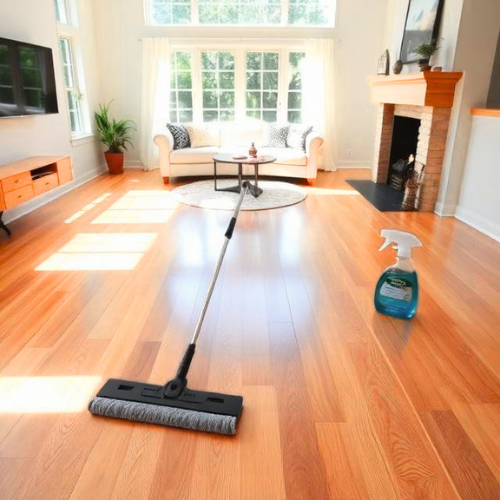
Excess moisture, high alkalinity, and wax-based formulas are the three biggest killers of a beautiful hardwood finish. The best cleaner for wood floors is always pH-neutral, fast-drying, and residue-free.
Bona Hardwood Floor Cleaner
⭐ Editor’s Pick, Pet Safe, GREENGUARD Certified, pH Neutral
Bona is the cleaner professional floor installers recommend more than any other brand — and after testing it across a dozen different hardwood finishes, we understand exactly why.
The water-based, pH-neutral formula dries almost instantly, leaving absolutely zero residue or haze behind.
Works brilliantly as a daily maintenance spray and handles everything from dried coffee to tracked-in mud. GREENGUARD Gold certified for safe indoor air quality.
✦ Pros
- Zero residue — truly streak-free
- GREENGUARD Gold certified
- Fast-drying formula
- Works with Bona spray mop system
- Widely available in USA
✦ Cons
- Not a disinfectant
- Pricier than concentrate options
- Not for unfinished wood
Murphy’s Oil Soap — Wood Floor Cleaner
American Classic Since 1910, 98% Natural Ingredients, Budget-Friendly
Murphy’s has been cleaning American hardwood floors for over a century. Formulated from 98% naturally derived ingredients including vegetable oil soap, it cleans and lightly conditions wood surfaces.
Best used properly diluted as a concentrate — the ratio matters. A beloved classic, especially on older solid hardwood floors with non-polyurethane finishes.
✦ Pros
- Excellent value as concentrate
- 98% naturally derived
- Light conditioning effect on wood
- Pleasant, clean scent
✦ Cons
- Can leave buildup if diluted incorrectly
- Not recommended for polyurethane — check your finish
⚠️
Never Use on Hardwood
Avoid vinegar, bleach, ammonia-based cleaners, steam mops, and any product not formulated for sealed hardwood. Vinegar’s acidity gradually erodes polyurethane finish. Steam moisture causes warping and swelling between planks. These mistakes are irreversible.
Lorem ipsum dolor sit amet, consectetur adipiscing elit. Ut elit tellus, luctus nec ullamcorper mattis, pulvinar dapibus leo.
Best Tile Floor Cleaning Solutions
Ceramic and porcelain tile floors are among the most forgiving to clean — the tile itself is virtually indestructible — but grout is an entirely different story. Grout is porous and acts like a sponge for dirt, bacteria, and mold.
The best tile floor cleaning solution needs to clean both surfaces effectively while being safe enough for regular use without degrading grout sealant.
Zep Neutral pH Floor Cleaner (Concentrate)
Commercial Grade, Best Value, No Rinse Formula
If you’re dealing with large tile areas — a kitchen, entryway, or bathroom — Zep’s professional-grade concentrate delivers genuinely impressive results at a fraction of comparable costs.
The neutral pH is safe on grout sealant, and the no-rinse formula means no film, no streaks, no second pass needed. A gallon concentrate makes up to 64 mop buckets of solution.
✦ Pros
- Exceptional value per use
- Professional-strength cleaning
- Safe on grout sealant
- No rinse required
- Works in traditional and spray mops
✦ Cons
- Scent is neutral/plain — not pleasant
- Must measure dilution carefully
Best Laminate Floor Cleaners
Laminate floors look like hardwood but behave very differently. They’re made from a photographically printed layer under a clear wear layer — and that wear layer absolutely cannot handle excess moisture,
strong chemicals, or abrasive scrubbing. The best cleaner for laminate floors dries instantly and never leaves streaks or haze.
Black Diamond Wood & Laminate Floor Cleaner
⭐ Top Pick for Laminate, Streak-Free, Fast Dry
Black Diamond has quietly become the laminate floor cleaner of choice among USA cleaning professionals.
The streak-free formula is genuinely streak-free — unlike competitors that only achieve this under perfect lighting.
Safe for use on hardwood, laminate, vinyl, tile, and stone surfaces. The concentrate option offers excellent economy for larger homes.
✦ Pros
- Works on every common floor type
- Truly streak-free in any light
- Pleasant, light scent
- Available as concentrate
✦ Cons
- Not a disinfectant formula
- Limited in-store availability
Best Natural & Non-Toxic Floor Cleaners
If you have a baby crawling on the floor, a dog licking paws after walking through a freshly mopped room, or someone with fragrance sensitivities, a natural floor cleaner isn’t a nice-to-have — it’s essential.
The good news: the best non-toxic floor cleaners of 2025 are genuinely as effective as their conventional counterparts.
Better Life Floor Cleaner
Plant-Based, EWG Verified, No Artificial Fragrance, Vegan & Cruelty-Free
Better Life was formulated by two chemists who were also new dads — which explains its obsessive commitment to ingredient transparency.
Every compound is plant-derived and listed on the label. No synthetic fragrances, no parabens, no petroleum-based surfactants.
Cleans tile, hardwood, laminate, and vinyl beautifully while leaving a light citrus mint scent.
EWG Verified means every ingredient has passed the Environmental Working Group’s strict safety screening.
✦ Pros
- 100% transparent ingredient list
- EWG Verified — highest safety standard
- Works on all sealed floor types
- Genuinely pleasant natural scent
- Safe around babies, pets, allergy sufferers
✦ Cons
- Not antibacterial/disinfecting
- Higher price than conventional options
Method Squirt + Mop Hard Floor Cleaner
Biodegradable, Certified B Corp, 4 Scent Options
Method’s squirt-and-mop formula is wonderfully convenient — squirt directly onto the floor, mop through, done.
The plant-based cleaning agents are biodegradable, the bottles are made from 100% recycled plastic, and it comes in four genuinely lovely scents including Ginger Yuzu and Almond. Perfect for quick cleanups and daily maintenance mopping.
✦ Pros
- Incredibly convenient squirt-and-mop system
- Beautiful scent options
- B Corp certified brand
- 100% recycled bottle
✦ Cons
- Ready-to-use only — no concentrate
- Not as strong on heavy grime
Best Floor Cleaner Safe for Pets
Pet owners face a unique cleaning challenge: strong enough for biological messes, yet completely safe for animals who walk, sit, and often lick the surfaces you’ve just cleaned.
We looked for cleaners without phenols (toxic to cats), pine oil in high concentrations (dangerous to dogs), and benzalkonium chloride (harmful to pets at certain concentrations).
Angry Orange Pet Floor Cleaner (Enzyme Formula)
⭐ Best for Pet Homes, Enzyme-Based, Eliminates Odors at the Source
The enzyme formula in Angry Orange is real biochemistry. When pet urine dries, it crystallizes and becomes notoriously difficult to eliminate.
Enzyme cleaners break down those crystallized compounds at the molecular level — which is why the smell doesn’t come back after repeated enzyme treatments.
Works on hardwood, tile, laminate, and vinyl. The citrus scent dissipates cleanly after drying.
✦ Pros
- True enzymatic odor elimination
- Safe for cats and dogs after drying
- Works on all sealed floor types
- Concentrate is economical
✦ Cons
- Strong citrus scent initially
- Needs to dry before pet re-access
Pet Safety Tip
Even pet-safe cleaners should dry completely before allowing animals back onto cleaned floors. Most enzyme and plant-based cleaners need 3–5 minutes of air-drying time. Always ensure good ventilation when mopping, and store all cleaning solutions in locked cabinets away from pets.
Best Floor Cleaning Solution for Families with Kids
Toddlers and young children spend an enormous amount of time on floors — playing, crawling, eating dropped snacks.
The floor isn’t just a walking surface in a home with kids; it’s practically a second table. That reality demands a completely different standard for what you mop with.
For families, we prioritize: no synthetic fragrances (linked to respiratory irritation), no formaldehyde-releasing preservatives, no quaternary ammonium compounds, and full ingredient transparency.
Our top recommendation: Better Life Floor Cleaner and Branch Basics Concentrate — a multipurpose concentrate made from only six plant-derived ingredients.
The “Floor Test” for Families
Before using any new cleaner in a home with young children, look it up on the EWG Healthy Living database (ewg.org). Products rated A or B are vetted as safe for children’s exposure. It takes 30 seconds and is always worth doing.
DIY Floor Cleaning Solutions That Actually Work
Sometimes the best floor cleaning solution is the one you make yourself. For certain floor types, a properly formulated DIY solution genuinely outperforms commercial alternatives in terms of residue levels, cost, and customization. Here are three tested formulas.
Formula 1: All-Purpose Tile & Vinyl Cleaner
Best for: Ceramic tile, porcelain, vinyl, LVP. Not for hardwood or laminate.
- 1 gallon warm water
- ½ cup white vinegar
- Few drops dish soap
- 10 drops essential oil (optional)
- Fill bucket with 1 gallon warm (not hot) water.
- Add ½ cup white distilled vinegar and stir.
- Add 2–3 drops dish soap to break surface tension.
- Add essential oil if desired — lavender and tea tree have mild antimicrobial properties.
- Mop with a well-wrung microfiber mop, rinsing the pad regularly.
Formula 2: Safe Hardwood Refresher Spray
Best for: Sealed hardwood floors between deep cleans only.
- 2 cups water
- ½ cup rubbing alcohol
- ½ tsp dish soap
- Combine in spray bottle and gently swirl (avoid excess bubbles).
- Lightly mist 3–4 square feet at a time — never saturate.
- Wipe immediately with a dry microfiber pad.
- Alcohol ensures rapid evaporation, protecting your finish.
Formula 3: Deep-Clean Grout Paste
Best for: Periodic deep cleaning of tile grout lines. Not for daily use.
- ½ cup baking soda
- ¼ cup hydrogen peroxide
- 1 tsp dish soap
- Mix into a thick paste.
- Use an old toothbrush to apply directly onto the grout lines.
- Let sit 10–15 minutes — hydrogen peroxide provides gentle oxidizing action.
- Scrub and rinse thoroughly with clean water.
Commercial vs. Homemade Floor Cleaners — Honest Comparison
Factor | Commercial Products | DIY / Homemade | Winner |
Cost per use | $0.08–$0.20 | $0.01–$0.04 | 🏆 DIY |
Consistency | Precise, tested formulas | Variable by batch | 🏆 Commercial |
Disinfecting power | Many options available | Limited (vinegar ~65% germ kill) | 🏆 Commercial |
Ingredient transparency | Often poor labeling | Complete — you made it | 🏆 DIY |
Hardwood safety | Specifically formulated options | Only alcohol/soap blends | 🏆 Commercial |
Scent control | Limited to product scent | Fully customizable | 🏆 DIY |
Convenience | Ready to use | Requires prep | 🏆 Commercial |
Environmental impact | Plastic packaging, chemicals | Reusable containers, simple ingredients | 🏆 DIY |
Verdict: For hardwood and laminate, commercial products designed for those surfaces are the safer, more reliable choice.
For tile, vinyl, and LVP, a well-formulated DIY solution works brilliantly. Many savvy homeowners use both — commercial for hardwood maintenance, DIY for tile deep-cleans.
Best Floor Cleaning Solution for Kitchen Floors
Kitchen floors face a different kind of punishment than any other room. Cooking grease, food spills, and constant traffic around the stove and sink mean you need genuine degreasing power.
Tile and LVP are the most common kitchen floor materials, and both benefit from a mildly alkaline solution (pH 8–9) that cuts through cooking oils without leaving a slippery film.
Our top pick for kitchen floors: Zep Neutral pH Concentrate or Method All-Floor Cleaner. For greasy buildups around the stove, a small amount of Dawn dish soap in warm water, applied and quickly removed with a microfiber mop, is one of the most effective kitchen floor treatments available.
Pro Kitchen Floor Tip
Always sweep or vacuum before mopping — especially in the kitchen. Mopping over crumbs just spreads them around and embeds them into grout. A quick 2-minute sweep makes your mop solution dramatically more effective.
Best Bathroom Floor Cleaning Products
Bathroom floors need a cleaner addressing three distinct problems: hard water mineral deposits, soap scum buildup, and genuine disinfection for hygiene. U
nlike other rooms, bathroom floors actually benefit from periodic use of a disinfecting cleaner — particularly around the toilet area.
For routine bathroom mopping, Seventh Generation Concentrated Disinfecting Multi-Surface Cleaner is a standout: EPA-registered, kills 99.9% of bacteria, made with thymol from thyme oil rather than harsh synthetic biocides.
For hard water stains specifically, a diluted citric acid solution (2 tablespoons citric acid powder in 1 quart water) dissolves mineral deposits from tile and grout without damaging sealant.
How to Clean Floors Without Streaks
Streaks are almost never caused by the cleaning product itself — they’re caused by technique. Here’s what creates them and exactly how to prevent them:
💧Too much solution: Using more cleaner doesn’t make floors cleaner — it leaves visible residue. Follow dilution instructions precisely.
🪣Dirty mop water: Change your mop water every 200–300 sq ft. Mopping with dirty water deposits more grime than it removes.
🔄Wrong mop direction: Mop in the direction of floorboards or grout lines, with overlapping S-shaped passes. Random circular scrubbing creates visible patterns.
☁️Hard water: Hard water leaves chalky film on floors. Use filtered water or add a splash of white vinegar to mop water for tile floors.
🌬️Slow drying: Open windows or turn on a fan while mopping so floors dry before residue sets.
Common Floor Cleaning Mistakes to Stop Making Today
- Using a steam mop on hardwood or laminate. Heat and moisture is devastating to wood-based floors. Steam causes irreversible warping, swelling, and finish damage within weeks of regular use.
- Mopping without sweeping first. Dragging a wet mop through dry debris doesn’t clean — it scrapes the floor and pushes dirt into grout lines. Sweep every single time before mopping.
- Using vinegar on hardwood. Extremely common online advice that’s genuinely damaging. Vinegar’s acidity slowly but permanently degrades polyurethane and aluminum oxide finishes.
- Skipping the floor type check. “Safe for all floors” usually means safe for most tile. Always verify your specific floor type before using any new product on wood-based floors.
- Not rinsing concentrate cleaners fully. With concentrate products on tile, under-rinsing leaves a sticky, dirt-attracting residue that makes floors look worse faster.
- Reusing dirty mop pads. A pad loaded with last week’s grime is depositing bacteria, not removing it. Machine-wash microfiber pads after every use.
How Often Should You Mop Your Floors?
🍽️Kitchen
Weekly or after any major cooking/spill event. High-traffic + grease = most frequent cleaning need.
🚿Bathroom
Weekly routine, full disinfecting mop every 2 weeks minimum. Daily spot-wipe as needed.
🛋️Living Room
Every 1–2 weeks for hardwood or LVP. Monthly for low-traffic areas.
🐾Pet Areas
2–3x per week minimum. After any visible accident, treat immediately with enzyme cleaner.
👶Baby/Kid Zones
2–3x per week with pet/child-safe cleaner. Pre-sweep before every mop.
🚪Entryway
Weekly — this is where most outdoor dirt enters. A good entry mat reduces this dramatically.
Best Cleaning Tools to Pair with Your Solution
🧹Spray Mop + Microfiber Pad
The daily driver for most homeowners. Lightweight, convenient, ideal for quick maintenance on hardwood and LVP. Bona and O-Cedar make the most reliable versions.
🪣Traditional Bucket + Flat Mop
Best for deep-cleans of large tile or vinyl areas. Control dilution precisely and rinse the mop pad repeatedly. O-Cedar EasyWring is our top pick.
♨️Steam Mop
Excellent for sealed tile, natural stone, and porcelain. Use plain water only — no cleaning solution in the reservoir. NEVER on hardwood or laminate.
🤖Robot Mop (Roborock, iRobot Braava)
Game-changing for busy families. Daily maintenance cycles while you sleep. Use only compatible, low-foam formulas in the reservoir.
Real-Life Floor Cleaning Scenarios & Solutions
🐕
Two Labs, Oak Hardwood, Mudroom
Daily paw prints, occasional accidents. Needs: pet-safe enzyme cleaner safe for hardwood. Best routine: dry sweep daily, enzyme spray mop twice weekly.
Angry Orange + Bona Spray Mop
👨👩👧👦
Family of 5, Tile Kitchen, High Traffic
Daily cooking messes, kids’ snacks, heavy foot traffic. Needs: non-toxic degreaser safe for kids, cost-effective concentrate.
Better Life + O-Cedar Mop
🏢
Apartment Dweller, Mixed Laminate & Tile
Limited storage, needs one versatile solution, small budget. Streak-free on laminate, effective on bathroom tile.
Black Diamond Concentrate
🌿
Eco-Conscious Homeowner, LVP Throughout
Wants certified natural cleaner, no plastic waste, effective on vinyl plank. Monthly budget: under $8.
DIY Vinegar Mix + Method Refill
Full Product Comparison — Best Floor Cleaners
Product | Floor Types | Pet Safe | Kid Safe | Eco Rating | Scent | Best For |
Bona Hardwood | Hardwood, LVP, Laminate | ✓ | ✓ | B+ | Light/Fresh | Hardwood maintenance |
Better Life Floor | All sealed floors | ✓ | ✓✓ | A | Citrus Mint | Families w/ babies & pets |
Zep Neutral pH | Tile, Stone, LVP | ~ | ~ | C | Neutral | Large tile, budget |
Black Diamond W&L | All sealed floors | ✓ | ✓ | B | Light Floral | Laminate, multi-floor homes |
Angry Orange Enzyme | All sealed floors | ✓✓ | ✓ | B | Strong Citrus | Pet odor & stain elimination |
Method Squirt+Mop | Hardwood, Tile, Laminate | ✓ | ✓ | A- | 4 options | Daily maintenance, eco homes |
Murphy's Oil Soap | Hardwood (non-poly) | ✓ | ✓ | B+ | Natural Wood | Older solid hardwood |
DIY Vinegar Mix | Tile, LVP only | ✓ | ✓ | A+ | Custom | Budget tile/vinyl cleaning |
Expert Floor Cleaning Tips from Professionals
Check your floor’s finish first.
Do the “water droplet test” — drop a small amount on your floor. If it beads up, it’s sealed. If it absorbs, you have unfinished wood requiring a completely different approach.
Less is almost always more.
The single biggest mistake is using too much product. A light, even application with a well-wrung mop out-cleans a soaking-wet mop every time.
Change your mop pad, not just your water.
Microfiber pads carry bacteria and old residue. Wash them after every use — they’re machine washable and last hundreds of uses.
Room temperature water beats hot.
Hot water can prematurely dry some formulas before they’ve done their cleaning work. Warm-to-room-temp water gives cleaning agents their full working time.
Mop in a figure-8 pattern.
This maximizes surface contact and ensures you’re always pushing debris toward the head of the mop rather than spreading it around.
Give cleaners 30–60 seconds dwell time on tough spots.
Spray, let sit briefly, then mop over. This “dwell time” massively improves efficacy on dried-on spills.
Spray Mop vs Traditional Mop — Which Should You Use?
Factor | Spray Mop | Traditional Bucket Mop |
Setup time | 30 seconds | 3–5 minutes |
Moisture control | Excellent — micro-spray | Variable — depends on wringing |
Cost | $30–70 + refills | $20–55 + solution |
Deep cleaning power | Moderate | Excellent for large areas |
Best floor type | Hardwood, LVP, Laminate | Tile, large stone areas |
Storage | Compact, upright | Requires bucket storage |
Ideal user | Daily maintenance, small-medium homes | Weekly deep-cleans, large homes |
Our recommendation: Spray mop for wood-based floors as the safer daily tool. Traditional bucket-and-mop for primarily tile or stone floors in larger homes needing periodic heavy cleaning.
FAQ About Floor Cleaning Solutions
What floor cleaning solution is safe for pets?
Pet-safe floor cleaners contain no phenols (toxic to cats), no pine oil in high concentrations, no benzalkonium chloride, and no artificial fragrances.
Top pet-safe picks: Angry Orange Enzyme Cleaner, Better Life Floor Cleaner, and Method Squirt + Mop. With any cleaner, allow floors to dry completely — typically 3–5 minutes with good ventilation — before pets re-enter the area.
Can I use the same floor cleaning solution on all floor types?
Technically yes with some multi-surface formulas, but not ideally. Hardwood needs neutral pH and minimal moisture; laminate needs fast-drying, low-residue formulas; tile handles more alkaline solutions; natural stone requires pH-neutral only.
A multi-surface cleaner is a fine compromise, but floor-specific products always deliver better results on your primary floor type over time.
How do you make a natural cleaning solution for floors?
For tile and vinyl: mix ½ cup white distilled vinegar with 1 gallon of warm water, add 2–3 drops of dish soap, and optionally 10 drops of lavender or tea tree essential oil.
For hardwood floors: skip the vinegar entirely — mix 2 cups water with ½ cup rubbing alcohol and ½ teaspoon dish soap in a spray bottle for a safe homemade hardwood cleaner that dries rapidly without damaging the finish.
What's the best non-toxic floor cleaner for homes with babies?
For baby-safe floor cleaning, look for EWG Verified or Leaping Bunny certified products with fully transparent ingredient lists. Better Life Floor Cleaner is our top pick — EWG Verified, plant-based, and free from synthetic fragrances and petroleum surfactants.
Branch Basics Concentrate is another excellent option. For tile with crawling babies, a simple warm water and castile soap mixture is entirely safe and effective.
Can I add cleaning solution to a steam mop reservoir?
Most steam mop manufacturers explicitly recommend plain water only in the reservoir. Adding solutions can damage internal components, void the warranty, and leave residue on floors.
A few brands make steam mop-compatible solutions for their specific models. Steam itself (212°F) kills most bacteria — use plain steam for sanitizing, then do a dry mop pass with a lightly scented spray separately if desired.
Final Recommendations — Our Expert Summary
After testing more than 30 products across multiple floor types, homes, and lifestyles, here’s our honest summary: if you have one floor type, invest in the best product specifically formulated for it — Safe baby for EWG Verified Better Life Floor Cleaner. Bona for hardwood, Black Diamond for laminate, Zep for tile.
If your home has mixed flooring, Better Life or Black Diamond Concentrate is the most versatile safe choice. Pet owners should keep an enzyme cleaner like Angry Orange in the rotation regardless of other products used. And if you’re on a tight budget, a DIY vinegar solution for tile and LVP genuinely works — just keep it away from hardwood.
Above all: read the label for your floor type before you buy. The best floor cleaning solution for your home is the one designed for your specific floors, household, and lifestyle. Everything else is just noise.