
Glass vs Plastic Food Storage Containers
Glass vs Plastic Food Storage Containers: Which Is Better for Your Kitchen?
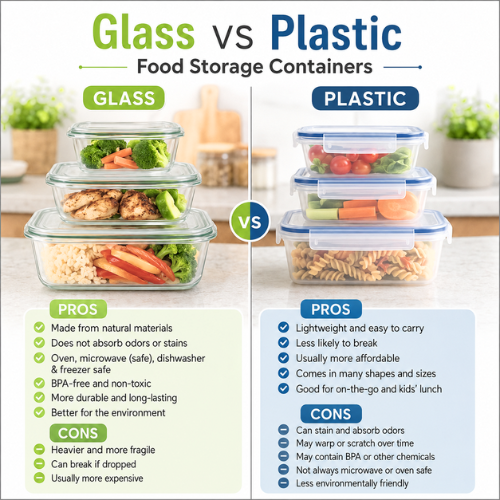
Featured Snippet Answer
Glass food containers are generally better for health, longevity, and sustainability, since they don’t leach chemicals, resist stains and odors, and last for years.
Plastic containers are lighter and more affordable, making them better for on-the-go use and school lunches.
The best choice depends on your priorities: glass wins for home use and meal prep; plastic wins for portability and tight budgets.
Introduction
Most people pick up a set of food storage containers without giving it much thought. You grab whatever’s on sale, stack it in the cabinet, and move on.
Then, a few months later, you notice your tomato sauce left a permanent orange stain. Or you warmed up leftovers and caught a faint chemical smell. Or the lids started warping after a few dishwasher cycles.
That’s when the glass vs. plastic question starts to matter.
The truth is, these two materials behave very differently in your kitchen — in the microwave, in the freezer, over years of daily use, and yes, inside your body when you eat food that’s been stored in them. This guide explains all the key differences so you can make a clear, confident decision.
Quick Comparison: Glass vs. Plastic at a Glance
Feature | Glass | Plastic |
Health Safety | ✅ No chemical leaching | ⚠️ Risk with low-quality plastics |
BPA-Free | ✅ Always | ✅ If labeled BPA-free |
Microwave Safe | ✅ Most types | ✅ If labeled safe |
Oven Safe | ✅ Borosilicate only | ❌ Generally no |
Freezer Safe | ✅ Yes (leave headspace) | ✅ Yes |
Stain Resistance | ✅ Excellent | ❌ Absorbs colors |
Odor Resistance | ✅ Excellent | ❌ Absorbs odors |
Dishwasher Safe | ✅ Yes | ✅ Top rack only (most) |
Durability | ⚠️ Can break if dropped | ✅ Impact-resistant |
Weight | ❌ Heavier | ✅ Lightweight |
Upfront Cost | ❌ Higher | ✅ Lower |
Long-Term Value | ✅ Outlasts plastic | ⚠️ Needs replacing |
Eco-Friendly | ✅ Recyclable, durable | ⚠️ Recyclability varies |
Health and Safety: What You Actually Need to Know
This is where most people have the most questions — and the most confusion.
Glass is an inert material. That means it doesn’t react with food, even acidic foods like tomato sauce, citrus, or vinegar.
Nothing migrates from the container into your food. Period. That’s a pretty significant advantage when you’re talking about something you’re putting in your mouth every day.
Plastic is more complicated. It’s not inherently dangerous, but certain types — especially older, lower-quality, or improperly used plastics — can release small amounts of chemical compounds into food under certain conditions. Heat, acidity, and wear all accelerate this process.
The FDA has established safety standards for food-contact plastics, and manufacturers must comply. But “safe within regulatory limits” isn’t the same as “zero exposure.” For health-conscious households, especially those with young children, that distinction matters.
What the Recycling Numbers Mean
The number inside the recycling triangle on plastic containers tells you what kind of plastic it is:
#1 (PETE/PET): Single-use water bottles. Not for reuse.
#2 (HDPE): Milk jugs, some food containers. Generally safe for reuse.
#4 (LDPE): Squeeze bottles, some bags. Generally safe.
#5 (PP/Polypropylene): Most food storage containers. One of the safest options.
#3, #6, #7: Avoid for food storage. #7 May contain BPA unless otherwise labeled.
For reusable food containers, you want #2, #4, or #5. Most reputable brands like Rubbermaid, OXO, and Pyrex Freshlock now use polypropylene (#5) for their lids and containers.
BPA and Chemical Leaching
BPA (bisphenol A) became a household concern in the late 2000s when research linked it to hormonal disruption, developmental issues in children, and other health risks. Most major brands have since removed BPA from their products and now label containers “BPA-free.”
But here’s what doesn’t get talked about enough: some BPA-free plastics use replacement compounds — like BPS (bisphenol S) or BPF — that early research suggests may carry similar risks.
The science is still developing, but if you’re the type who wants to minimize exposure entirely, glass eliminates the question altogether.
Glass never leaches anything. There’s no BPA, no BPS, no phthalates, and no concern about what happens when you microwave leftovers.
For families with infants or toddlers, pregnant individuals, or anyone undergoing medical treatment that makes them more sensitive to environmental chemicals, that certainty is worth paying for.
Expert Insight
The National Institute of Environmental Health Sciences (NIEHS) notes that people are exposed to BPA through food and beverage containers, and that reducing that exposure through material choices is a practical step.
While regulatory agencies like the FDA maintain current exposure levels are safe, many consumer health advocates recommend using glass or stainless steel when possible, especially for heating food.
Durability: Which Lasts Longer?
This one splits in two directions depending on what “durable” means to you.
Glass resists almost everything except impact. It won’t scratch, warp, crack from heat, or degrade over time. A set of quality borosilicate glass containers can last 10, 15, even 20 years with basic care.
The trade-off is obvious: drop it on a tile floor and it breaks. Glass containers also develop chips along the rim over time, which can be a safety concern.
Plastic holds up to drops. It’s impact-resistant and practically shatterproof, which is why it’s the go-to choice for kids, travel, and work lunches.
But plastic degrades in ways glass never does. It scratches (and those scratches harbor bacteria), warps in the dishwasher or microwave over time, and discolors.
Most plastic containers realistically last 2–5 years before they need replacing — and that’s with careful use.
The Hidden Cost of Plastic’s “Cheaper” Price
A set of plastic containers might cost $15–$25 and last a few years. A comparable set of glass containers might run $40–$60 but last a decade or more.
Over 10 years, glass is often the more cost-effective purchase — and that’s before factoring in the environmental cost of repeatedly buying and discarding plastic.
Microwave, Oven, and Freezer Safety
Temperature performance is one of the most practical factors for daily use.
Microwave Safety
Both glass and quality plastic containers can be microwave-safe — but with important caveats.
Glass: Most glass food containers are microwave-safe. Borosilicate glass (used by brands like Pyrex and OXO) handles temperature changes particularly well.
Standard soda-lime glass is also usually fine for microwave use, though it’s less tolerant of sudden temperature swings. Always check the label; glass with metallic paint or trim is not microwave-safe.
Plastic: Look for containers explicitly labeled “microwave-safe.” This means the plastic has been tested for heat resistance and is less likely to warp or release compounds when heated.
Even so, many experts recommend transferring food to a glass or ceramic dish before microwaving, especially for fatty or high-acid foods, which leach more compounds from plastic.
Oven Safety
This is where glass pulls significantly ahead. Borosilicate glass containers from brands like Pyrex are oven-safe up to 425°F–450°F, making them ideal for reheating casseroles, roasting vegetables, or baking leftovers directly in the storage container. Plastic containers should never go in a conventional oven.
Freezer Safety
Both materials work in the freezer with one rule for glass: leave headspace. Liquids expand when frozen, and glass will crack if filled to the brim.
About an inch of space at the top prevents breakage. Plastic is slightly more forgiving here, though it can become brittle at very low temperatures.
Cleaning and Dishwasher Performance
Glass wins decisively here. Glass is non-porous, which means food particles, oils, and bacteria don’t embed in the surface. A quick run through the dishwasher or a hand-wash leaves glass genuinely clean. Glass containers can go on the bottom rack of the dishwasher and handle high-heat drying cycles without issue.
Plastic is more problematic in the dishwasher. Most plastic containers are labeled “top rack only” — the high heat on the bottom rack can warp lids, containers, and the seals that make them airtight. Over repeated cycles, plastic can develop micro-scratches that trap food residue and bacteria.
Hand-washing plastic in hot, soapy water and air-drying is the gentlest option if you want to extend its life. But for time-strapped households, the glass-goes-anywhere-in-the-dishwasher advantage adds up quickly.
Odor and Stain Resistance
This is one of the clearest wins for glass — and one of the most common frustrations with plastic.
Anyone who has stored spaghetti sauce in a plastic container knows the result: a permanent orange tint that no amount of scrubbing removes.
The same goes for turmeric, beet juice, tomato soup, and curry. Plastic’s porous surface absorbs pigments and holds them.
Odors are even worse. Store strong-smelling food in plastic — garlic, onions, fish, heavily spiced dishes — and the container will smell like that food for weeks. Sometimes permanently.
Glass doesn’t absorb anything. Wash it, and it’s clean. Store kimchi in it, then store birthday cake. No transfer of smell, no staining.
For households that cook a variety of cuisines or do regular meal prep, this practical benefit is substantial.
Weight, Portability, and Everyday Use
This is where plastic genuinely earns its place in most kitchens.
A glass container holds roughly 2–3 times the weight of a comparable plastic one — and that adds up when you’re packing a work bag, sending kids to school, or loading up a cooler for the park. A full glass lunch container with food can easily weigh over a pound; a plastic equivalent might be under half that.
For commuters, students, athletes, and kids, plastic is the practical choice. It doesn’t shatter if dropped, fits easily in bags, and doesn’t feel like a liability when you’re rushing out the door.
Glass containers are best suited for home storage, countertop use, batch cooking, and any situation where you’re not carrying them very far.
Portability Tip
If you love glass but need portability, look for sets that include silicone-sleeved glass containers. The silicone protects against drops, adds grip, and makes glass significantly more travel-friendly.
Cost Comparison: Upfront vs. Long-Term Value
Container Type | Average Starter Set Cost | Expected Lifespan | 10-Year Cost |
Budget Plastic | $15–$35 | 1–2 years | $50–$100+ |
Mid-Range Plastic | $25–$50 | 3–5 years | $40–$80 |
Budget Glass | $25–$40 | 8–15 years | $25–$40 |
Premium Glass | $50–$80 | 10–20+ years | $50–$80 |
The numbers point to the same conclusion: glass often costs less in the long run, even when the upfront price is higher.
Quality glass containers like Pyrex glass storage containers, OXO glass storage containers, or Snapware glass storage containers don’t need to be replaced nearly as often as plastic equivalents.
The upfront cost gap matters most for households on tight budgets. A $15 set of Rubbermaid plastic containers solves the problem today; that’s a real consideration.
But if budget allows, investing in a modest glass set — even just for leftovers and meal prep — pays off within a few years.
Environmental Impact
This has become an increasingly important factor for American households. Here’s the honest comparison:
Glass
- Made from natural materials (silica sand, soda ash, limestone)
- Infinitely recyclable without quality loss
- Higher carbon footprint to manufacture and transport (heavier)
- Lasts decades, reducing frequency of replacement
Plastic
- Made from petroleum byproducts
- Most recycling programs accept #1 and #2 plastic; many don’t accept #5 (polypropylene, the most common container type)
- According to the EPA, only about 9% of all plastic ever produced has been recycled.
- Lighter to ship, which reduces transportation emissions
- Contributes to microplastic pollution over time
The lifecycle advantage goes to glass for most consumers. Even though glass manufacturing is energy-intensive, a glass container that lasts 20 years is almost always more environmentally responsible than replacing plastic containers every few years.
If sustainability is a key factor in your purchase decision, glass is the cleaner choice — particularly if you participate in a municipal glass recycling program.
Best Use Cases for Each Type
When Glass Is the Better Choice
- Storing acidic foods (tomato sauce, citrus, vinegar-based dishes)
- Reheating leftovers in the microwave or oven
- Long-term pantry storage (beans, grains, pasta)
- Batch cooking and meal prep at home
- Foods with strong smells (fish, curries, fermented foods)
- Baking and cooking when you want oven-to-table convenience
- Health-conscious households wanting to minimize chemical exposure
When Plastic Is the Better Choice
- Kids’ school lunches (drop-proof)
- Work lunches carried in bags or backpacks
- Travel, picnics, and outdoor dining
- Freezer storage in high volume (lighter, stacks efficiently)
- Budget-conscious households starting fresh
- Snacks and dry foods that don’t interact with the plastic
Which Is Better for Meal Prep?
For serious meal preppers, this question deserves its own section.
If you’re prepping 5–7 days of food at once, you’re likely dealing with hot food, high-acid sauces, oily proteins, and aromatic spices — all the conditions where plastic underperforms. Glass meal prep containers handle all of this without absorbing smells or staining.
The ability to go from oven to fridge to microwave without switching containers also saves real time. Roast your chicken thighs directly in a glass container, let it cool, snap on the lid, refrigerate, then microwave directly from the fridge the next day. No added cleanup required.
The weight downside is real for meal preppers packing lunch bags. A common workaround is to store and reheat food at home in glass containers, then move it to a separate insulated lunch bag with a cold pack when you need to take meals with you.
Best glass meal prep containers to look for:
- Pyrex Simply Store – classic, affordable, widely available
- OXO Good Grips Glass – excellent lids, leakproof
- Snapware Total Solution – airtight, stackable
- Prep Naturals Glass Meal Prep Containers – portion-sized, budget-friendly
Which Is Better for Families?
Families have competing needs: safety for kids, practicality for parents, budget realities, and the chaos of school mornings. There isn’t one definitive answer, but here’s a practical breakdown:
For infants and toddlers: always use glass or stainless steel. Tiny bodies are more sensitive to chemical exposure, and the FDA’s safety thresholds are built for adult exposure levels. For purées, snacks, and any food that will be heated, avoid plastic entirely.
For school-age kids: This is where plastic makes sense. Kids drop things, forget containers on the school bus, and stuff their backpacks with no regard for fragile materials. A BPA-free polypropylene container is the realistic choice. Look for one-piece construction with no small parts to lose.
For parents’ own meal prep: Glass. You control it, you don’t drop it, and you’ll appreciate not having orange-stained containers after tomato soup.
A blended approach works best for most families. Use glass containers for home storage and adult use, and reserve a set of high-quality BPA-free plastic containers for kids and packed lunches. You don’t need to choose one or the other.
Pros and Cons Summary
Glass Food Containers
Pros:
- Zero chemical leaching — completely inert
- Resists stains, odors, and discoloration
- Oven-safe (borosilicate)
- Dishwasher-safe on any rack
- Lasts 10–20+ years
- Better long-term value
- More sustainable and recyclable
Cons:
- Heavier than plastic
- Breaks when dropped
- Higher upfront cost
- Requires headspace when freezing liquids
- Not ideal for travel or kids’ use
Plastic Food Containers
Pros:
- Lightweight and portable
- Shatterproof — great for kids and travel
- Affordable upfront
- Wide variety of shapes and sizes
- Freezer-friendly in high volumes
Cons:
- May leach chemicals over time (especially when heated)
- Absorbs stains and odors
- Degrades, warps, and scratches with use
- Most aren’t bottom-rack dishwasher safe
- Not oven-safe
- Environmental concerns with recycling and microplastics
How to Choose: A Decision Guide
Use this to find your best fit:
You should prioritize glass if:
- You heat food in containers regularly
- You store acidic or strongly scented foods
- Health and chemical exposure concern you
- You typically cook at home most of the time.
- You’re willing to invest more upfront for long-term value
- Sustainability is a priority for your household
You should prioritize plastic (BPA-free) if:
- You pack lunches for kids or commuters daily
- Portability and drop-resistance matter more than chemical concerns
- Budget is the primary driver
- You need lightweight containers for travel or camping
- You’re storing dry goods or foods that don’t need reheating
You should use both if:
- You have a mix of at-home meal prep and on-the-go needs (most households)
- You want glass for the fridge and plastic for the lunch bag
- You have kids and adults with different usage patterns
FAQ
Q: Are glass food containers really safer than plastic?
Glass is the safer choice if chemical exposure is a concern. Glass is inert and never leaches chemicals, regardless of what’s stored, how hot the food is, or how old the container is.
BPA-free plastic is much safer than older plastics, but it can still leach small amounts of compounds when heated or scratched.
Q: Can you microwave food in plastic containers?
Only in containers explicitly labeled “microwave-safe.” Even then, many food safety experts recommend using glass or ceramic for heating food, particularly fatty or acidic dishes, which tend to draw more compounds out of plastic.
Q: Do glass containers break easily?
Standard glass containers will break if dropped on a hard floor. However, borosilicate glass is considerably more impact-resistant than standard glass and handles temperature extremes far better. Silicone sleeves add another layer of protection for daily use.
Q: What's the best type of plastic for food storage?
Polypropylene (#5 PP) is widely considered the safest and most heat-resistant plastic for food storage. Look for containers labeled BPA-free, and replace any plastic containers that are cracked, scratched, or cloudy.
Q: Are glass containers better for meal prep?
Yes, for home-based meal prep. Glass handles the oven-to-fridge-to-microwave workflow better than plastic, doesn’t absorb spice smells, and won’t stain from sauces or curries. The weight is a trade-off if you’re packing and carrying meals.
Q: How long do glass food containers last?
With basic care, quality glass containers can last 10–20 years or longer. The main failure points are chips along the rim (usually from dishwasher contact) and lids wearing out. Lid replacements are available for most major brands.
Q: Is plastic food storage bad for the environment?
Plastic food containers have a meaningful environmental impact. Most polypropylene (#5) containers aren’t accepted by curbside recycling programs.
Over time, plastic degrades and contributes to microplastic pollution. Glass is recyclable indefinitely and doesn’t contribute to microplastics.
Q: What are the best glass food storage containers for the money?
Pyrex Simply Store, OXO Good Grips, Snapware Total Solution, and Anchor Hocking are consistently rated among the best value glass food storage containers in the U.S. For premium options, Weck glass jars and Glasslock are excellent for airtight storage.