
Best Air Fryer Buying Guide: How to Choose the Best Air Fryer for Your Kitchen
Written by Ibrahim Khalil – Authority at The HomeDecor Review ( Author Bio )
Introduction
Walk into any American kitchen store in 2026, and you’ll find an entire wall dedicated to Air Fryer Buying Guide. Dozens of brands. Hundreds of models. Prices ranging from $39 to $400. No wonder so many shoppers walk away more confused than when they arrived.
This air fryer buying guide exists to cut through that noise. Whether you’re a first-time buyer wondering if air frying is even worth the hype, a busy parent cooking for four, or someone upgrading from a basic basket to a smarter, more capable machine — this guide has you covered.
We’ve spent months researching air fryer categories, testing models across price points, and talking to real cooks who use these countertop appliances daily.
By the end, you’ll know exactly which type of air fryer fits your kitchen, your family size, and your cooking habits — and you’ll feel confident enough to hit “Add to Cart” without second-guessing yourself.
What Is an Air Fryer?
At its core, an air fryer is a compact countertop kitchen appliance that uses superheated circulating air to cook food — producing results remarkably similar to deep frying, but with little to no oil. Think of it as a highly efficient convection oven shrunk down to the size of a large coffee maker.
The term “Air Fryer Buying Guide” can be a bit misleading. You’re not actually frying anything in the traditional sense — no hot oil bath, no splattering grease.
What you get instead is a Maillard reaction on your food’s surface (the same browning process responsible for the appealing crust on fried chicken or golden fries) powered by hot air moving at high velocity.
The result: crispy exteriors, juicy interiors, and a fraction of the calories compared to oil-submerged cooking.
Since Philips introduced the first consumer air fryer in 2010, the category has exploded. Today, it’s one of the fastest-growing segments in the countertop kitchen appliances market, with Americans purchasing over 40 million units annually.
And once you’ve made crispy brussels sprouts or perfect homemade fries in 15 minutes flat, it’s easy to understand why.
Quick Definition
An air fryer is a countertop convection cooking appliance that circulates superheated air around food at high speed to achieve fried-like results with minimal or zero oil.
How Air Fryers Work
Understanding the mechanics helps you buy smarter. An air fryer uses a heating element—typically positioned at the top—along with a powerful fan to circulate hot air. When you set your temperature and timer, here’s what happens:
The heating element quickly activates to warm the air. The fan drives that hot air in a tight circular pattern around the food inside the basket or chamber.
Food is heated evenly from all sides at the same time, unlike a conventional oven where heat mainly comes from above or below.
This continuous, high-speed airflow strips away surface moisture, creating that coveted crispy texture — all without the need to submerge food in hot oil.
Most air fryers reach temperatures between 175°F and 400°F (some go higher). The combination of high heat and rapid airflow means cooking times are typically 20–40% shorter than a standard oven, making air frying genuinely energy-efficient for everyday cooking.
The Science
The Maillard reaction — responsible for that irresistible golden-brown crust — kicks in around 280°F. Air fryers reach and maintain this temperature faster than conventional ovens, which is why your food browns and crisps more efficiently.
Benefits of Using an Air Fryer
The air fryer’s rise from trendy gadget to kitchen staple didn’t happen by accident. Here’s why millions of American households now consider them essential:
Oil-Free and Healthy Cooking
The biggest draw for most buyers is health. Oil-free cooking (or near oil-free — many recipes call for just a light spray) can reduce caloric intake from fat by up to 75% compared to traditional deep frying.
For families trying to eat cleaner without sacrificing the foods they love, that’s significant. Crispy sweet potato fries, crunchy chicken tenders, even donuts — all achievable with a fraction of the oil.
Speed and Convenience
Most weeknight meals come together in 15–25 minutes. Because air fryers preheat faster than ovens and cook at higher effective temperatures due to forced airflow, a meal that might take 45 minutes in a standard oven can be table-ready in half that time.
Versatility Beyond “Frying”
Modern air fryers can roast, bake, grill, dehydrate, and reheat. A quality oven-style air fryer can replace your toaster oven, countertop convection oven, and dehydrator. That’s real countertop and cabinet space recovered.
Energy Efficient Cooking
An air fryer uses roughly 1,500–1,800 watts. A standard electric oven uses 2,000–5,000 watts, and takes 10–15 minutes to preheat. For meals under 30 minutes, an air fryer is almost always the more energy-efficient cooking choice — a meaningful savings over a month of daily cooking.
Easy Cleanup
Most air fryer baskets and inserts are dishwasher safe. Without gallons of used frying oil to dispose of, the post-cooking cleanup takes minutes instead of an elaborate kitchen cleanup production.
Ideal for Meal Prep
Meal prep enthusiasts love air fryers for batch-cooking proteins and vegetables. A 6-quart basket can handle a full pound of chicken thighs or a sheet pan’s worth of roasted vegetables in a single run, keeping meal prep sessions shorter and less exhausting.
Types of Air Fryers
Walk into any appliance aisle and you’ll encounter at least four distinct air fryer formats. Each has a distinct cooking profile, footprint, and ideal use case. Choosing the wrong type — even a great model — leads to buyer’s remorse.
Basket vs. Oven Air Fryers: The Core Decision
This is the first and most important choice you’ll make. Everything else flows from it.
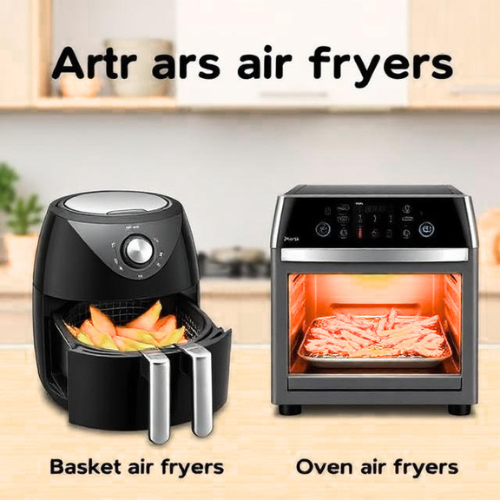
Basket-Style Air Fryers
The original format. Food sits in a pull-out perforated basket that allows air to circulate underneath as well as above and around. Results tend to be crispier and faster — the basket design maximizes airflow contact.
The tradeoff is capacity: most baskets max out at 6–8 quarts, and you often need to shake or flip food halfway through cooking. Great for: fries, wings, nuggets, small proteins, vegetables.
Oven-Style Air Fryers (Air Fryer Toaster Ovens)
These look like compact toaster ovens with an air fry function built in. You get a larger rectangular cooking chamber, a glass door (so you can monitor food without opening it), and often multiple rack positions.
They’re less crispy than basket fryers for small batches, but they can handle a whole rotisserie chicken, two racks of pizza, or a full batch of dehydrated fruit simultaneously. Ideal for families cooking larger quantities, or anyone who wants an oven replacement on their countertop.
Feature | Basket Air Fryer | Oven Air Fryer |
Crispiness | ⭐⭐⭐⭐⭐ Excellent | ⭐⭐⭐⭐ Very Good |
Capacity | 2–8 qt (single basket) | 10–32 qt (multi-rack) |
Footprint | Compact, vertical | Larger, horizontal |
Visibility During Cooking | Limited | Glass door |
Versatility | Moderate | High (roast, bake, toast, dehydrate) |
Ease of Use | ⭐⭐⭐⭐⭐ Very simple | ⭐⭐⭐⭐ Simple |
Price Range | $50–$200 | $80–$400 |
Best For | 1–4 people, small kitchens | Families, versatile cooks |
Dual-Zone Air Fryers
A newer format, popularized by Ninja, featuring two independent basket compartments that can run at different temperatures simultaneously.
You can cook chicken at 375°F in one zone and vegetables at 325°F in the other — and sync them to finish at the same time.
A game-changer for families who are tired of coordinating timing across multiple appliances. Dual-zone models generally cost more, with prices usually ranging from $150 to $380.
Compact/Mini Air Fryers
At 2–3 quarts, these are built for studio apartments, dorm rooms, RVs, and anyone cooking for one. They’re inexpensive (often under $80), but their small capacity means you’re cooking in batches if you want more than a single serving.
Ideal as a secondary appliance for a beach house or office kitchen, though less suitable as the main refrigerator for a family of four.
Our Recommendation
Most households (2–4 people): A 5–7 quart basket air fryer covers 90% of daily cooking needs at the best price-to-performance ratio. Families of 5+: an oven-style or dual-zone model will serve you much better.
Best Air Fryer Sizes Explained
Buying an air fryer that’s too small means cooking in frustrating batches. Buying one that’s too large wastes counter space and electricity. Here’s how to size it right.
Household Size | Recommended Capacity | Best Format | Typical Price |
1 person / Single | 2–3 quarts | Compact basket | $35–$70 |
2 people / Couple | 3–4 quarts | Basket | $60–$120 |
3–4 people / Small family | 5–7 quarts | Basket or oven | $80–$200 |
5–6 people / Large family | 8–10 quarts | Dual-zone or oven | $150–$280 |
Meal prep / Entertaining | 10+ quarts | Oven-style | $150–$400 |
Sizing Tip
Manufacturers list total basket volume, but usable cooking space is usually 60–70% of that number. A “6-quart” basket practically holds enough food for 3–4 servings. When in doubt, size up by one tier — you’ll appreciate the headroom.
Key Features to Look For
Not all air fryers are created equal, even within the same price range. Here are the features that separate genuinely useful machines from disappointing ones:
Temperature Range and Precision
A wide temperature range — ideally 175°F to 400°F or higher — makes your air fryer more versatile. You want low temperatures for dehydrating (165°F), moderate for delicate fish (325°F), and high for crisping fries and wings (390–400°F).
Digital air fryer models with precise degree-by-degree control beat dial-based models for anything beyond simple cooking.
Preset Programs
Most mid-range and premium air fryers include one-touch presets for fries, chicken, fish, steak, vegetables, and baked goods.
These are genuinely useful for beginners — think of them as guardrails that put you in the right ballpark. Experienced cooks often customize beyond presets, but having them speeds up the learning curve.
Shake Reminder
For basket-style models especially, a mid-cook shake reminder is a small feature that makes a real difference.
It alerts you halfway through cooking to toss or flip your food, which is what separates evenly golden fries from a batch that’s crispy on one side and pale on the other.
Non-Toxic Coating and Materials
This matters more than most buyers realize. Look for PFOA-free and BPA-free labels on nonstick coatings.
Some premium brands now offer ceramic-coated baskets, which are harder than traditional nonstick and free of synthetic polymer concerns.
If you want the most non-toxic air fryer possible, consider stainless steel interior models — though these are typically found in higher-end oven-style units.
Wattage and Power
For most households, 1,400–1,800 watts is the sweet spot. Lower wattage means longer preheating and slower cooking; higher wattage is faster but uses more electricity and may require a dedicated outlet. If your kitchen has a standard 15-amp circuit, stick to 1,800W or below to avoid tripping breakers.
Ease of Cleaning
An easy-clean air fryer isn’t a luxury — it’s what keeps you actually using the appliance. Look for: dishwasher-safe basket and tray, non-stick (but durable) interior, a removable crumb tray (critical for oven styles), and minimal crevices where grease accumulates. Avoid models with mesh baskets that are difficult to scrub by hand.
Smart Features and WiFi Connectivity
Smart air fryers connect to a smartphone app for remote control, recipe libraries, and cooking guidance. Models from Cosori, Ninja, and Instant Brands offer app connectivity. Are smart features essential? No.
Are they genuinely useful for tech-savvy households? Yes — especially built-in recipe libraries that automatically set time and temperature for hundreds of dishes.
Best Air Fryers for Different Needs
Best Air Fryer for Families
Families need capacity above all else. A dinner for four or five requires at least 5–6 quarts of usable basket space — which means buying a 6–7 quart model or going with a dual-zone or oven-style unit.
Key priorities: large basket, durable build quality, powerful wattage for fast cooking, and a price point that doesn’t feel punishing when a toddler eventually drops the basket on the kitchen floor.
Best Air Fryer for Family — Our Pick Category
What to look for: 6–10 qt capacity, 1,700W+, dual-zone option for cooking two items simultaneously, dishwasher-safe basket, sturdy construction.
Dual-zone basket models from Ninja and comparable brands in the $150–$380 range dominate this category.
Look for models with a “Sync Finish” function so both zones finish at the same time — this alone eliminates the biggest source of family-meal timing frustration.
✓ Pros — Large Family Air Fryer
- Cook full meals for 4–6 people in one go
- Dual zones eliminate timing juggling
- More versatile for batch cooking & meal prep
- Often includes more preset programs
✗ Cons — Large Family Air Fryer
- Larger footprint takes more counter space
- Higher price point ($150–$280)
- Heavier to move or store
Best Air Fryer for Small Kitchens
If counter space is your biggest constraint, you need to think not just about the capacity you want, but the footprint you can live with.
A 3–4 quart compact basket fryer has roughly the same countertop footprint as a large coffee maker. Some models are also designed to store vertically or flat in a cabinet, which matters enormously in galley kitchens and studio apartments.
Measure Before You Buy
Always check manufacturer dimensions before purchasing. Most air fryers need at least 5–6 inches of clearance above the unit for safe ventilation. Measure your under-cabinet clearance before choosing a model.
For the air fryer for small kitchen buyer, compact basket models in the 3–5 quart range are the answer. They’re adequate for 1–3 people, keep countertop clutter minimal, and often store more easily. An added bonus: compact air fryers are almost always cheaper, freeing up budget for quality accessories.
Best Budget Air Fryers
You absolutely do not need to spend $200 to get a capable, reliable Air Fryer Buying Guide. The best budget air fryer options — typically in the $35–$80 range — deliver solid performance for everyday cooking, especially for single cooks or couples.
What you typically sacrifice at the low end: digital precision controls (some budget models use mechanical dials), smart features, and premium nonstick coatings.
Price Tier | Capacity Range | What You Get | What You Give Up | Best For |
Budget $35–$80 | 2–5 qt | Basic frying & reheating, dial or simple digital controls | Smart features, premium coating, large capacity | Singles, students, light users |
Mid-Range $80–$160 | 5–7 qt | Precise digital controls, presets, shake reminder, dishwasher-safe parts | Smart app, dual zones, premium materials | Most households |
Premium $160–$400 | 7–32 qt | Smart WiFi, dual zones, oven versatility, stainless build | Just money (mostly) | Large families, power users |
Budget Buyer Caution
Below $35, quality control becomes inconsistent. Nonstick coatings can chip or scratch more easily, and cheaper heating elements may not maintain consistent temperature. We recommend budgeting at least $55–$65 for a unit you’ll actually use daily without frustration.
Smart Air Fryers Worth Buying
The best smart Air Fryer Buying Guide does more than connect to an app — it genuinely makes cooking easier. Look for models where the app includes a real recipe library that auto-programs the fryer, not just a remote control interface for your existing cooking method.
WiFi-connected smart air fryers typically run $120–$250 and are most useful for households that love exploring new recipes or want guided cooking for beginners.
Voice assistant compatibility (Alexa, Google Home) is available on select models — a nice feature for hands-free timer management, less essential than a quality recipe library.
If you’re buying a smart fryer primarily for tech appeal rather than genuine cooking utility, save the money and buy a better mid-range non-smart model.
Stainless Steel vs. Nonstick Models
This is a question we get constantly from health-conscious shoppers, and it deserves a nuanced answer.
Nonstick (PTFE/Teflon) Models
Traditional nonstick coatings are excellent for easy food release and cleanup, but they carry a concern: when scratched or heated above 500°F, older PTFE coatings can release fumes.
Reputable brands now use PFOA-free nonstick coatings (PFOA was the truly dangerous component, phased out by most manufacturers years ago).
If you buy from a recognized brand and avoid metal utensils inside the basket, PFOA-free nonstick is safe for daily use.
Ceramic-Coated Models
Ceramic coatings are free from PTFE and PFAS chemicals entirely. They’re harder than traditional nonstick and more scratch-resistant, but they can lose their nonstick properties faster if not properly cared for.
A good ceramic-coated basket with gentle hand washing can last years. Dishwasher use degrades the ceramic coating faster — hand washing extends life significantly.
Stainless Steel Air Fryers
True stainless steel interior air fryers are the most non-toxic option, with no coating concerns at all. They’re typically found in oven-style models.
The tradeoffs: food sticks more readily (use silicone liners or a light oil spray), and cleanup takes more effort.
For buyers prioritizing a truly non-toxic cooking environment above all else, a stainless steel air fryer paired with quality silicone liners is the gold standard.
Material | Non-Toxic Rating | Ease of Cleaning | Durability | Price Impact |
PFOA-free Nonstick (PTFE) | ✓ Safe when intact | ⭐⭐⭐⭐⭐ Easiest | ⭐⭐⭐ Moderate | Lowest |
Ceramic Coating | ✓✓ Excellent | ⭐⭐⭐⭐ Easy | ⭐⭐⭐⭐ Good | Moderate premium |
Stainless Steel Interior | ✓✓✓ Best | ⭐⭐⭐ Requires effort | ⭐⭐⭐⭐⭐ Excellent | Higher |
Common Mistakes Buyers Make
After surveying hundreds of air fryer owners, we’ve identified the most consistent mistakes that lead to buyer disappointment — and how to avoid every one of them.
Buying Too Small
The single most common complaint. A 3-quart model that seemed “plenty big” for a couple quickly becomes a batch-cooking chore when you’re hosting three people or making a meal with multiple components. Be honest about your real household size and cooking ambitions, then size up by one tier from your initial instinct.
Ignoring Noise Levels
Air fryers have fans. Those fans make noise — typically 60–65 decibels, similar to a normal conversation.
Some models run louder. If you have an open-plan home, work from home, or have sleeping children nearby, noise level is worth researching before you buy.
Overlooking Clearance Requirements
Air fryers vent hot air from the back, sides, or top. Placing one flush against a wall or cabinet can be a fire hazard and shortens the appliance’s lifespan. Always check the manufacturer’s required clearance — typically 5–8 inches on all sides.
Choosing Cheap Nonstick Without Checking Certifications
Very low-cost models from unknown brands may use nonstick coatings that haven’t been certified PFOA-free.
Stick to brands that clearly disclose their coating certifications — it matters for your family’s health, especially when cooking at high temperatures daily.
Not Considering Accessories Upfront
Silicone liners, grill pans, and stacking racks can significantly expand what your air fryer can do. Many buyers discover accessories later and wish they’d accounted for the cost upfront. Budget an extra $20–$40 for a core accessories starter kit when you buy your unit.
Skipping the Manual
Sounds obvious, but many new users underperform their air fryer because they don’t understand basic calibration — like the fact that most basket models don’t require preheating, or that overfilling the basket is the number-one cause of soggy, undercooked food.
Cleaning and Maintenance Tips
An air fryer you can easily clean is an air fryer you’ll actually use. Here are the habits that keep your machine performing well and lasting years:
Clean after every use. Don’t let grease and food residue accumulate. A 2-minute wipe-down after the basket cools is infinitely easier than scrubbing baked-on grease after a week of cooking.
Use warm soapy water, not harsh abrasives. For nonstick baskets, warm water and dish soap with a soft sponge is all you need. Steel wool and abrasive pads destroy nonstick coatings — never use them.
Soak stubborn residue. Fill the basket with warm soapy water and let it soak for 10 minutes before scrubbing. This loosens 95% of stuck-on food without any real effort.
Wipe the interior chamber. The outer cooking chamber (where the basket slides in) accumulates grease splatter. A weekly wipe-down with a damp cloth prevents buildup and odors.
Clean the heating element. With the unit unplugged and cooled, gently wipe the heating element at the top of the basket cavity with a slightly damp cloth. Accumulated grease on the element burns and smokes during cooking — and can eventually trigger your smoke alarm.
Use silicone liners. Reusable silicone liners and parchment air fryer liners dramatically reduce cleanup time. They prevent food from sticking to the basket, catch drips, and take seconds to wash. One of the best investments for any air fryer owner.
Odor Control
If your air fryer has developed an odor, place a small bowl of water with a few lemon slices in the basket and run it at 350°F for 3 minutes. The steam naturally deodorizes the interior without any chemicals.
Energy Efficiency and Safety
Air fryers are among the most energy-efficient cooking appliances you can buy for quick meals. Let’s put it in perspective: a standard 24-inch electric oven uses 2,000–5,000 watts and takes 10–15 minutes to preheat.
An air fryer uses 1,400–1,800 watts and requires little to no preheating. For a 20-minute cooking session, the average air fryer uses roughly 0.5 kWh of electricity versus 1.5+ kWh for an oven.
At 15 cents per kWh (the US average), that’s about 7 cents versus 22 cents per meal — modest savings that add up meaningfully over a year of daily cooking.
Safety Essentials
Air fryers are generally safe appliances, but a few precautions protect your household. Never leave an air fryer unattended for long cook times — though they’re significantly safer than deep fryers, any appliance with a heating element deserves respect.
Keep the unit away from water and from flammable materials. Place the appliance on a stable, heat-resistant surface before use. And always ensure proper clearance for ventilation as specified in your user manual.
For households with young children, some models include child-safety lock features on digital controls — worth specifically searching for if little hands tend to explore countertop appliances.
Air Fryer Accessories Worth Buying
The right accessories can truly maximize your air fryer’s potential and make everyday cooking much easier. Here are the ones we recommend:
Accessory | Why You Need It | Typical Price | Priority |
Silicone Liners | Reduces cleanup dramatically, prevents sticking | $10–$18 | Essential |
Oil Sprayer / Mister | Controls oil use precisely — a light mist evenly coats food | $10–$30 | Essential |
Stacking Racks / Multi-layer Insert | Doubles cooking capacity in one session | $12–$25 | Highly Recommended |
Grill Pan Insert | Creates grill marks, better airflow for steaks and fish | $15–$30 | Recommended |
Instant-Read Food Thermometer | Confirms proteins reach safe internal temperatures | $15–$35 | Essential for Food Safety |
Parchment Liners (Perforated) | Disposable liner option for ultra-easy cleanup | $8–$15 | Recommended |
Air Fryer Recipe Book | Expands cooking repertoire, especially for beginners | $12–$25 | Great for Beginners |
Magnetic Cheat Sheet Set | Quick-reference temperatures & times on the fridge | $8–$15 | Convenient |
Air Fryer Buying Guide Tips for Beginners
If this is your first Air Fryer Buying Guide, here’s a distilled checklist to guide your decision without overwhelm:
- Start with your household size. Use the sizing chart above as your anchor. Everything else is secondary to having enough capacity for your actual cooking needs.
- Decide basket vs. oven before anything else. If counter space is limited and you cook primarily for 1–4 people, a basket is almost always the right call. If you cook large quantities, bake, or want to replace a toaster oven, go oven-style.
- Set a realistic budget. The $80–$160 mid-range tier offers the best value for most buyers — full digital controls, solid build quality, and all the features you’ll actually use. Don’t overspend on smart features you won’t use; don’t underspend on quality so low it frustrates you within a month.
- Verify PFOA-free coating. Any reputable brand selling in the USA today should be able to confirm PFOA-free nonstick on their product listing. If this certification isn’t mentioned anywhere, move on.
- Buy at least two accessories upfront. A set of silicone liners and an oil mister will improve your cooking results from day one and keep cleanup manageable. Add a stacking rack if you’re buying a basket model — it’s the single most effective way to increase capacity.
6. Review the first 10 pages of the manual. Yes, really. Understanding your specific model’s preheating protocol, capacity guidelines, and cleaning instructions will make a meaningful difference in your results and your appliance’s longevity.
Frequently Asked Questions
Is an air fryer actually healthier than a regular oven or deep fryer?
Compared to deep frying, air frying is significantly healthier — using up to 75–80% less oil while achieving similar crispy results. Air frying and oven roasting at similar temperatures produce nutritionally comparable results.
Where air fryers shine is speed and convenience, which leads most users to cook at home more often rather than ordering out — which is arguably its biggest health benefit.
What is the best air fryer brand in the USA?
The consistently top-rated brands for USA buyers in 2025 are Ninja, Cosori, Instant (Instant Pot brand), Philips, and Breville for premium oven-style models.
Ninja leads in the dual-zone and large-basket categories; Cosori is frequently praised for its smart features and user-friendly app; Philips remains the gold standard for pure frying performance in classic basket designs.
The “best” brand depends entirely on which model fits your specific size and feature requirements.
Can I put aluminum foil or parchment paper in an air fryer?
Yes, with important caveats. You can use aluminum foil and parchment paper in an air fryer, but never cover the entire basket floor — doing so blocks the airflow that makes air frying work.
Always leave at least 30–40% of the basket open. Use perforated parchment liners specifically designed for air fryers, which allow airflow while catching drips.
Never preheat an empty air fryer with parchment paper inside — it can fly into the heating element.
How long do air fryers typically last?
A well-maintained air fryer from a reputable brand should last 3–5 years with daily use. Budget models used heavily may start showing issues (nonstick wear, fan noise) after 2–3 years.
Premium models with stainless interiors or ceramic coatings tend to have longer functional lifespans.
Proper cleaning — especially keeping the heating element free of grease — is the single biggest factor in appliance longevity.
Do air fryers increase your electricity bill?
Air fryers are actually more energy-efficient than conventional ovens for quick meals. A typical 1,700-watt air fryer running for 20 minutes uses approximately 0.57 kWh of electricity — about 8–9 cents at average US electricity rates.
An electric oven doing the same job uses roughly three times as much energy when preheating time is factored in. For daily cooking, the energy savings are real.
What’s the Difference Between an Air Fryer and a Convection Oven vs. a Convection Oven?
Both use circulating hot air to cook food, but air fryers do it in a much smaller, more concentrated space with a more powerful fan — which is why they produce crispier results faster.
A convection oven’s cooking chamber is larger, airflow is less intense, and it takes longer to preheat and cook.
Air fryers excel at crisping and frying-style cooking; convection ovens are better for baking and large roasts. Oven-style air fryers bridge the gap between the two.
Can you bake in an air fryer?
Yes — air fryers can bake cakes, muffins, cookies, brownies, and even bread, though with some limitations. The small cavity means you can’t bake in full sheet pan quantities, and heat distribution can be less even than a dedicated oven.
For small-batch baking (a half-dozen muffins, a small cake), an air fryer works very well. For serious baking, an oven-style air fryer with a larger chamber gives much better results than a basket model.
Which Foods Should You Avoid Cooking in an Air Fryer?
Air fryers aren’t ideal for foods with wet batter (tempura, beer-battered fish) since the batter drips before setting. Very large whole roasts can cook unevenly without a large-capacity oven-style unit.
Leafy greens can fly around and hit the heating element. And very wet foods can create steam that prevents crisping — pat proteins and vegetables dry before cooking for best results. Everything else is fair game.
Final Verdict
Our Final Recommendations
The Air Fryer Buying Guide market in 2026 is better than it’s ever been — smarter, larger-capacity, more versatile, and available at every price point. But the sheer number of options makes choosing one genuinely difficult without a framework.
Here’s ours: If you’re cooking for 1–2 people, a 3–4 quart basket model in the $60–$100 range will handle everything you need without wasting money or counter space. For families of 3–5, a 6–7 quart digital basket or a dual-zone model in the $120–$200 range is the sweet spot — enough capacity for full meals, smart enough for beginner-friendly cooking. Power users, large families, and serious home cooks should seriously consider a high-quality oven-style air fryer with multi-rack capability for true kitchen-appliance versatility.
Whatever you choose, prioritize: PFOA-free nonstick or ceramic coating, accurate digital temperature control, dishwasher-safe components, and a capacity tier that honestly matches your household — not the household you think you have.
Buy the right size. Buy from a brand that supports its products. Add silicone liners and an oil mister. Then cook dinner tonight in 20 minutes and wonder how you cooked without one for this long.
Related Articles


