
Best 15 Kitchen Organization Ideas to Declutter Your Space (Small Kitchen Friendly)
Written by Ibrahim Khalil – Authority at The HomeDecor Review ( Author Bio )
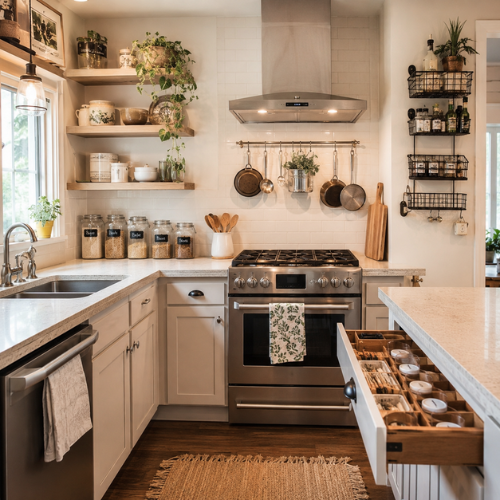
Quick Answer: How Do You Organize a Small Kitchen?
Start by decluttering everything you don’t use. Then maximize vertical space with floating shelves, use drawer dividers, add clear pantry containers, and organize by zones. Even the tiniest kitchen can feel spacious with the right system.
Introduction: Does Your Kitchen Feel Like Controlled Chaos?
You walk into your kitchen on a Tuesday morning, half-awake, reaching for your coffee mug – and knock over a tower of plastic containers that tumbles straight off the counter. Sound familiar?
Kitchen clutter is one of those sneaky stressors that creeps up slowly. One day you have a functional space, and the next you can barely find your cutting board under a pile of mail, random gadgets, and grocery bags you swore you’d reuse.
Here’s the thing: a cluttered kitchen costs you more than just storage space. It costs you time, energy, and that calm, “I’ve got my life together” feeling you’re absolutely entitled to.
The good news? You don’t need a full renovation or an unlimited budget to transform your kitchen. Whether you’re in a tiny apartment in Brooklyn or a starter home in the suburbs, these kitchen organization ideas will help you declutter, maximize every inch, and actually enjoy cooking again.
Let’s get into it.
Why Small Kitchens Feel So Cluttered
Before we start solving the problem, it helps to understand why it happens in the first place.
Small kitchens — especially apartment kitchens — weren’t exactly designed with modern life in mind.
You’ve got the air fryer, the Instant Pot, the coffee maker, the toaster, the blender… and suddenly your countertop has zero usable space.
Here’s what’s usually going wrong:
- Lack of dedicated storage zones — things end up where they “kind of fit”, not where they make sense
- Unused vertical space — most people stop thinking at eye level, leaving walls and upper cabinet space completely wasted
- Overcrowded countertops — when everything lives on the counter, nothing has a home
- Too many rarely used gadgets — that panini press you used twice in 2021 is taking up prime real estate
- Poor pantry organization — when you can’t see what you have, you buy duplicates, which creates even more clutter
The fix isn’t always buying more stuff. Often, it’s about using what you already have smarter.
The Best 15 Kitchen Organization Ideas (That Actually Work)
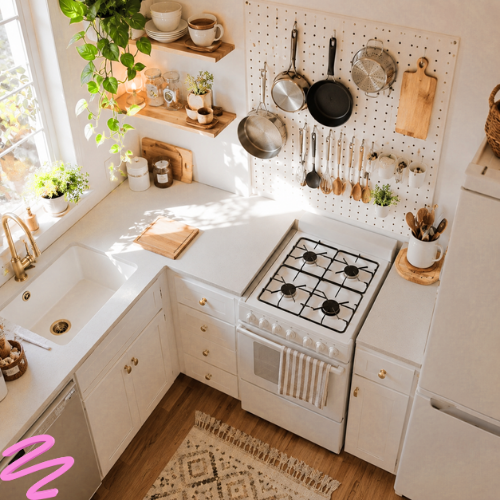
1. Use Vertical Wall Storage
The single most underused space in any kitchen? The walls.
Install a pegboard, wall grid, or tension rod system to hang pots, pans, utensils, and even small baskets. This instantly frees up cabinet and drawer space while keeping your most-used items accessible.
In a small kitchen, thinking vertically is a game changer. The goal is to get things off surfaces and onto walls.
Budget tip: A basic pegboard from a hardware store runs about $25–$45 and can be spray painted to match your kitchen aesthetic.
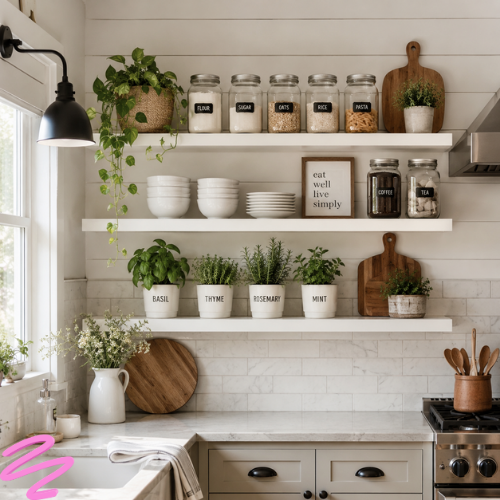
2. Add Floating Shelves
Open floating shelves are one of the most Pinterest-worthy small kitchen organization ideas — and for good reason. They add storage without making the room feel closed in.
Use them to display:
- Cookbooks
- Labeled pantry jars
- Everyday dishes
- Small plants for warmth
Keep them intentional. A shelf with 6 well-placed items looks chic. A shelf crammed with 30 things just moves the clutter upward.
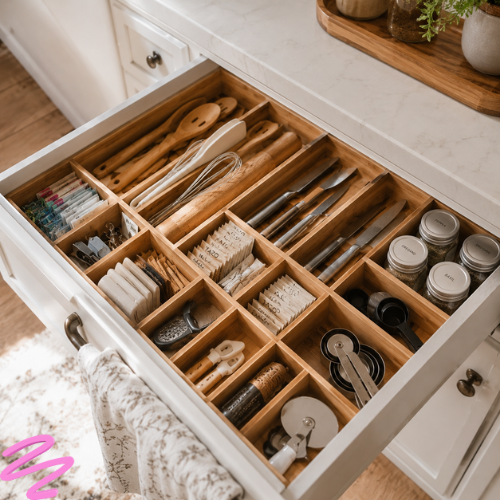
3. Use Drawer Dividers
Open a kitchen drawer and what do you usually find? A chaotic jumble of spatulas, rubber bands, old batteries, takeout menus, and a mysterious key that fits nothing.
Drawer dividers are one of the cheapest, highest-impact kitchen organization tools you can buy. Bamboo dividers or expandable plastic ones work great for:
Utensil drawers
- Junk drawers (yes, organize those too)
- Knife storage
- Spice packets and small bags
Pro tip: Empty the entire drawer first. Toss what you don’t need. Then organize what’s left. Don’t organize clutter — eliminate it.
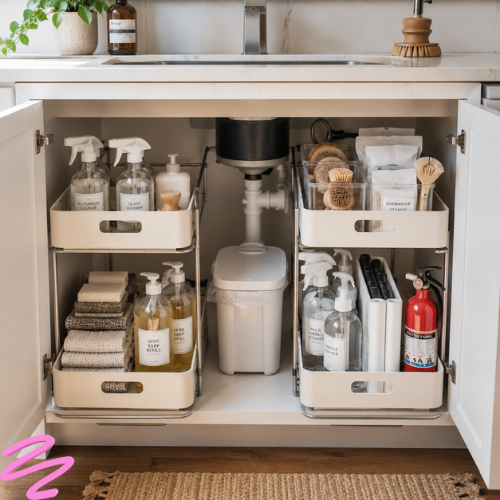
4. Install Under-Sink Organizers
The cabinet under your kitchen sink is either a black hole or prime real estate — your choice.
Most people shove cleaning supplies under there and forget about them. But with a two-tier pull-out organizer or an expandable shelf system, you can double the usable space without adding a single inch.
Great things to store under the sink:
- Cleaning products (in a caddy)
- Dish soap refills
- Trash bags
- Sponges and scrubbers
- A small fire extinguisher
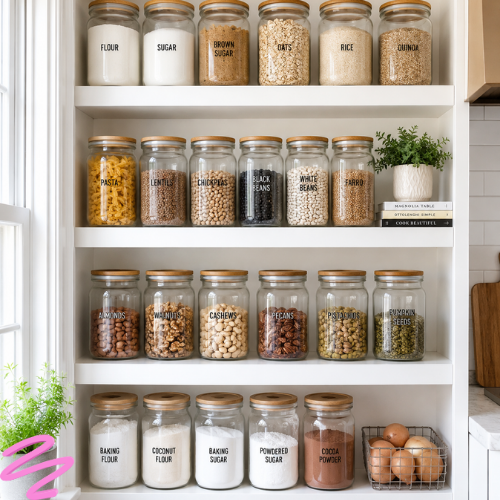
5. Use Clear Pantry Containers
This one is transformative — not just visually, but practically.
Storing dry foods like pasta, rice, oats, cereal, flour, and sugar in clear airtight containers lets you quickly see what you already have and how much remains. No more buying three boxes of pasta because you couldn’t see the ones hiding in the back.
Clear containers also:
- Keep food fresher longer
- Reduce packaging clutter
- Make your pantry look incredibly organized
OXO, Rubbermaid, and IKEA’s KORKEN jars are all solid, budget-friendly choices.
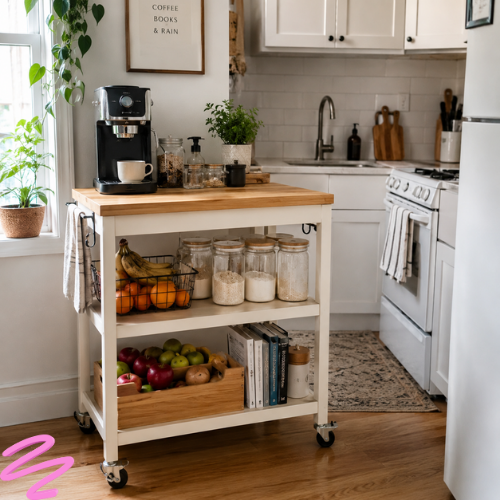
6. Add a Rolling Storage Cart
A rolling cart is one of the most flexible space-saving kitchen ideas out there — especially for renters who can’t drill holes or install permanent fixtures.
Use a rolling cart as the following:
- Extra counter prep space
- A bar cart or coffee station
- Portable storage for baking supplies
- A produce holder
You can tuck it into a corner when not in use or roll it wherever you need it. IKEA’s RÅSKOG cart is the cult favourite for a reason — it’s under $40 – $60 comes in multiple colours, and is endlessly versatile.
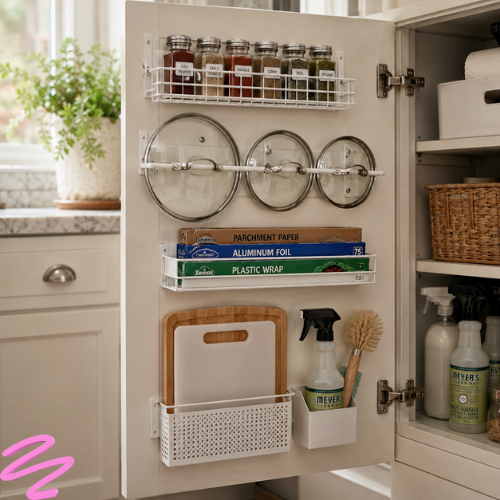
7. Use Cabinet Door Storage
The inside of your cabinet doors? Completely free real estate most people ignore entirely.
Add over-the-door organizers to store:
- Spices and small jars (inside pantry door)
- Pot lids (annoying to store any other way)
- Cleaning supplies
- Foil, plastic wrap, and bags
- Cutting boards
Command strips and tension rod systems work great for renters who can’t install screws.
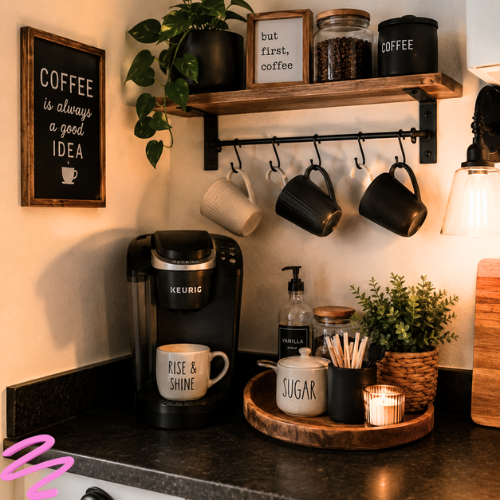
8. Create a Dedicated Coffee Station
A coffee station is one of those small kitchen organization ideas that makes your whole morning feel more intentional.
Gather your coffee maker, mugs, pods or beans, sugar, and creamer all in one spot — ideally a small corner of your counter or a rolling cart.
Add a small tray to contain it and suddenly it looks like a cozy café corner instead of scattered stuff.
Bonus: When things have a “home,” they actually get put back where they belong.
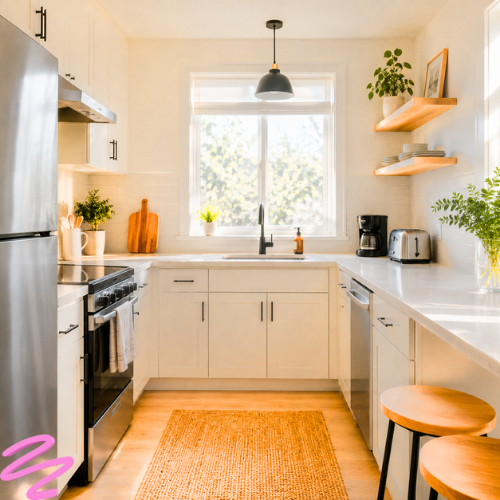
9. Declutter Your Countertops (Ruthlessly)
One simple rule can transform your kitchen: only keep everyday essentials on the countertop.
Your toaster? Yes. Your coffee maker? Absolutely. That bread maker you used on New Year’s Day 2020? Into the cabinet it goes.
Countertop clutter is the #1 reason small kitchens feel chaotic. Clear surfaces = a calmer, more functional space. Even removing two items from your counter makes the kitchen feel twice as large.
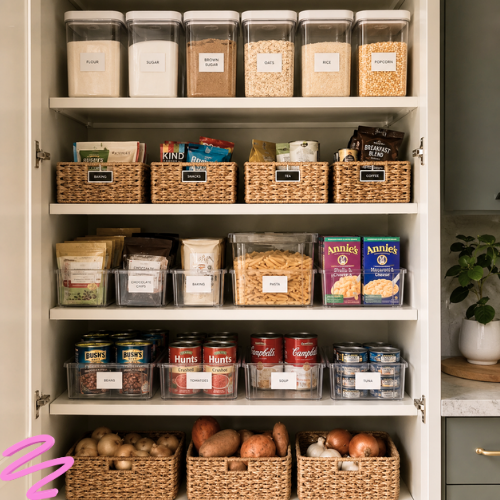
10. Use Stackable Bins and Baskets
Inside your cabinets and pantry, stackable bins let you use height efficiently. Group similar items together:
- Snack bin
- Baking supplies bin
- Pasta and grains bin
- Canned goods bin
Baskets work especially well on higher shelves where you need to pull everything down to see it — the basket becomes the unit you grab.
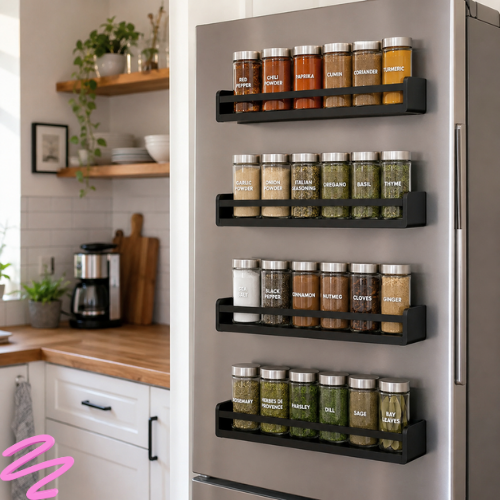
11. Add a Magnetic Spice Rack
Spices are notorious for eating up cabinet and drawer space. A magnetic spice rack mounts directly to your refrigerator or a metal wall strip, keeping all your spices visible and within arm’s reach.
This simple switch can open up a whole extra shelf in most kitchens.
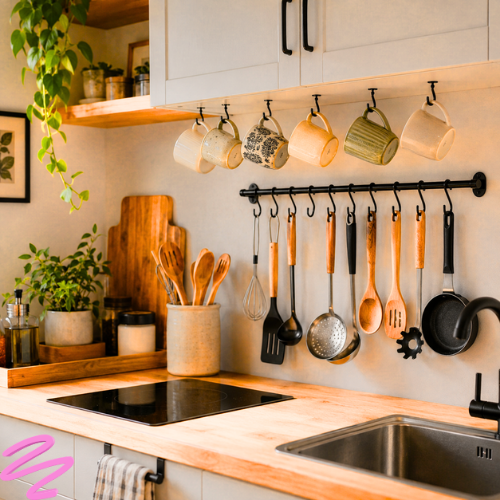
12. Use Hooks for Mugs and Utensils
Mug hooks under a shelf or cabinet keep your mugs accessible without taking up any cabinet shelf space. Utensil hooks on the wall or under cabinets do the same for your cooking tools.
This is especially handy in kitchens with limited drawer space.
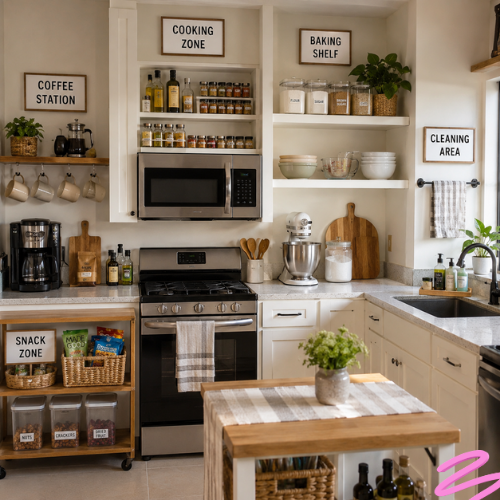
13. Organize by Zones
Think of your kitchen like a well-designed store. Everything should be logically grouped so you always know where to go.
Zone | What Goes There |
Coffee Zone | Mugs, beans, creamer, sugar |
Cooking Zone | Oils, spices, spatulas, pans |
Baking Zone | Flour, sugar, mixing bowls |
Snack Zone | Grab-and-go items, kids' snacks |
Cleaning Zone | Dish soap, sponges, towels |
When every item has a logical zone, you stop wasting time searching and start actually cooking.
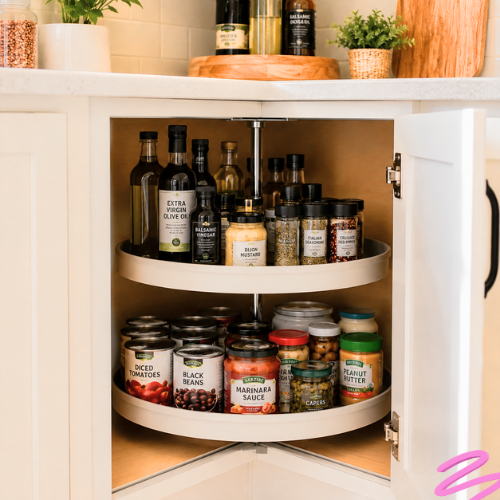
14. Lazy Susan Organizers
Corner cabinets are the Bermuda Triangle of kitchen storage. Things go in and never come out.
A Lazy Susan (a rotating turntable) fixes this completely. Pop one in a corner cabinet or even on a pantry shelf to make every item instantly accessible with a simple spin.
Great for:
- Oils and vinegars
- Spices
- Canned goods
- Condiments in the fridge
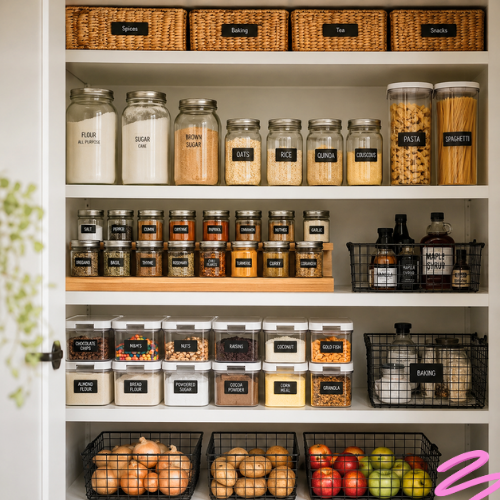
15. Label Everything
Labels might seem like overkill — until you use them and never go back.
When every basket, bin, and jar is labelled, your whole household knows where things go. Things actually get put back in the right place. The system maintains itself.
Use a label maker, printable labels, or even a chalk marker on glass jars for a farmhouse-chic look.
Small Kitchen Organization Hacks You'll Wish You Knew Sooner
Beyond the big changes, a few small habits make a massive difference:
- The One-In-One-Out Rule: Every time something new comes into the kitchen, something old leaves. This prevents creeping clutter.
- The Weekly Reset: Spend 10 minutes every Sunday putting things back where they belong and wiping down shelves. It’s so much easier than a monthly deep clean.
- Maximize Awkward Corners: Use corner shelf risers, tension rod organizers, or Lazy Susans to make use of spots most people ignore.
- Use the Back of the Fridge: Keep a “use first” bin at the front of every fridge shelf so older food gets used before it goes bad.
- Seasonal Declutter: Every few months, pull everything out, toss expired items, and reassess what’s earning its space.
Common Kitchen Organization Mistakes to Avoid
Even well-intentioned people make these mistakes. Skip them and save yourself time and money:
Buying organizers before decluttering. This is the one mistake. You end up with containers packed with things you never actually use. Always declutter first — then figure out what you need to organize what’s left.
Keeping rarely-used appliances on the counter. If you use it less than once a week, it doesn’t belong on your counter. Store it in a cabinet or donate it.
Ignoring vertical space. Most kitchens have 12–18 inches of usable space between the top of the cabinets and the ceiling — perfect for infrequently used items stored in labeled bins.
Overcrowding shelves. A shelf at 80% capacity is functional. A shelf at 110% is a frustrating mess that collapses the moment you need one thing at the bottom.
Organizing things where they’re convenient to store, not where you use them. Spices belong near the stove, not across the kitchen. Keep things where they make sense to use.
Budget-Friendly Kitchen Organization for Renters and Apartment Dwellers
You don’t need to spend hundreds of dollars to have an organized kitchen. Here’s how to do it on a real budget:
Item | Budget Option | Where to Find It |
Floating shelves | Command strip shelves | Amazon, Target |
Pantry containers | IKEA KORKEN jars | IKEA (starting per pices ~$2) |
Drawer dividers | Bamboo expandable dividers | Amazon (~$20) |
Rolling cart | IKEA RÅSKOG | IKEA (~$35) |
Spice rack | Magnetic fridge-mounted rack | Amazon (~$15–20) |
Under-sink organizer | Expandable plastic shelf | Dollar Tree, Amazon |
Labels | Chalk markers + glass jars | Craft stores |
Renter-friendly reminder: Stick to Command strips, tension rods, and freestanding solutions so you don’t lose your security deposit.
FAQ: Your Kitchen Organization Questions, Answered
How do I organize a very small kitchen?
Start by removing everything that doesn’t belong in the kitchen (mail, random items, etc.). Then declutter ruthlessly — keep only what you use regularly. Use vertical space with shelves and wall hooks, organize by zones, and keep countertops clear.
What is the best way to declutter a kitchen?
Pull everything out of one area at a time. Sort into keep, donate, and toss. Be realistic about the items you truly use. Once you’ve decluttered, then find organizing solutions for what remains.
How can I maximize kitchen storage space?
Use vertical wall storage, install floating shelves, add cabinet door organizers, use stackable bins, and utilize under-sink space. A rolling cart is also great for adding flexible storage without any installation.
What should I get rid of when decluttering my kitchen?
- Duplicate tools (how many spatulas do you actually need?)
- Expired spices, canned goods, and pantry items
- Broken or chipped dishes
- Appliances you haven’t used in 6+ months
- Excess plastic bags and containers without lids
Are kitchen organizers worth it?
Yes — when you buy them after decluttering. The right organizer for the right space saves time, reduces stress, and makes maintaining a clean kitchen dramatically easier.
Top 10 Kitchen Organization Tips at a Glance
- Declutter before you organize — always
- Use vertical wall space (pegboards, hooks, shelves)
- Clear the counters — only daily-use items stay
- Organize by zones
- Use clear containers in the pantry
- Add drawer dividers
- Maximize cabinet door storage
- Label everything
- Use a rolling cart for flexible storage
- Do a 10-minute weekly reset
Frequently Asked Question
Q. How much does it cost to organize a small kitchen?
A. A basic setup with drawer dividers, a pegboard, and pantry containers typically costs between $50 and $150.
You can start even cheaper using items you already own, then add tools gradually as budget allows.
Q. What is the 80/20 rule for kitchen organization?
A. The idea is that you use about 20% of your kitchen items 80% of the time. Keep that 20% (everyday tools) within easy reach, and store the rest — rarely used gadgets and seasonal items — in higher cabinets or less accessible spots.
Q. How do I organize kitchen cabinets without drawers?
A. Use stackable bins, tension rod dividers, and door-mounted organizers to create vertical sections inside open cabinet shelves. Lazy Susans also help make deep, drawer-less cabinets far more usable.
Q. Should I organize my kitchen by category or by how I use it?
A. Organizing by use (zones) generally works better than strict category grouping, since it matches your actual cooking workflow — for example, keeping baking tools together near where you bake, rather than scattered by type alone.
Q. How often should I reorganize my kitchen?
A. A quick 10-minute reset weekly keeps clutter from building up, while a deeper seasonal declutter every 3–4 months helps you reassess what’s actually still useful.
Q. What kitchen organizers are worth the investment for renters?
A. Command strip shelves, tension rod systems, freestanding carts, and drawer dividers are ideal for renters since none require permanent installation or drilling, protecting your security deposit.
Q. Can kitchen organization actually save money over time?
A. Yes—when you can clearly see what you already own, you’re far less likely to buy duplicate spices, pantry staples, or gadgets you forgot you had, which adds up to real savings over months.
Final Thoughts: Start Small, Change Everything
Here’s what I want you to remember: you don’t have to overhaul your entire kitchen in a weekend to feel the difference. Pick one small area — one drawer, one cabinet shelf, one corner of the counter — and start there.
That tiny win will give you the momentum to do the next one. And before you know it, you’ll walk into your kitchen in the morning, find your coffee mug exactly where it belongs, and feel that calm little exhale of “yes, I’ve got this.”
A well-organized kitchen isn’t just about storage. It’s about starting your day with less friction and more joy. It’s about cooking dinner without the stress of hunting for a lid. It’s about your home feeling like a place that works for you instead of against you.
You’ve got this. Now go find that one drawer to start with.
Related Articles